What happened to the books in the university bookstore?

Summer finds me in the midst of my Oregon Coast existence, a life I’ve built over the last 15 years or so, with roots that reach even further back in time—back to Eugene and Southern Oregon. This year my friend and colleague Patricia Santana decided to visit me here. On the day of her arrival, I headed over the coastal range to the Oregon State University Bookstore – her shuttle stop – thinking I could poke around until she got there.

I arrived to discover that the textbook area on the lower floor resembled an empty ballroom—no people or books to be seen. What surprised me, though, was the fact that they sold absolutely no trade books on the upper level—in the Beaver Store.

I guess I shouldn’t have been astonished. The small college bookstore supporting the school where I am currently employed dropped most of its meager trade book offerings awhile back. And many of my students insist, with a fair amount of vehemence, that – in time – there will be no more hard copy books. It will all be online, they say.

I’m definitely feeling like a dinosaur—analog—what have you. As I refrained from buying Beaver wear (my allegiance to my alma mater prevented me from picking up a much-needed pair of sweats), I thought about my former university bookstore in Eugene. I frequented it back in the early eighties, when it was the best place to while away some time after a long day of classes—or better yet, finals. I’d spend hours in there, pouring over the trade books, and I know some of my dorm-mates did the same. Once known as University Bookstore, it is called the Duck Store these days.

In 1988, I went on to attend the University of Washington, and I found their university bookstore offered an even more impressive trade book section, one that was especially busy around the holidays. In fact, I landed in Seattle and immediately encountered statistics like: Seattle has more readers per capita than any other city in the nation. Seattle is also often ranked the most literate city in the country, with its enthusiastic support of libraries and numerous bookstores.

While I continue to display shelves of good old fashioned books in my own home, I must confess, I finally broke down and started buying a few e-books last summer. I have not been fully converted, though I suspect I will continue to read them when I travel. However, I didn’t find e-books to be as convenient as some people purport them to be. One time, for example, I felt uncomfortable leaving my iPad (with its Kindle app) resting on a chaise lounge while I took a dip in a public swimming pool. I carried it back to my room first. Also, batteries do run out at inconvenient times. Finally, like many others, I like the smell and tactile quality of paper.

As a librarian, I’ve thought a lot about the digital divide, and I’ve done what I can to bridge it. I’d certainly like to see everyone have access to the information they need in order to live fulfilling lives, which means I also support the goal of finding ways to train people on the efficient use of information technologies.

I, myself, recently learned how to check out e-books and digital audio books (ultimately downloading them to my mobile device) from the San Diego Public Library. I didn’t even have to step through the door. To be sure, this was a convenient way for me to have plenty of books at my disposal during my time here in Oregon.

Public libraries are trying to keep up with all of these information format changes, but perhaps not all of their patrons will be able to do the same. Setting aside the issue of effective training, some people will never be able to afford the necessary devices—or keep up with the upgrades. I hope libraries continue to collect relevant hard copy books for such folks.

And when it comes to education, I can’t help but think that the simplicity of hard copy materials must make it easier for teachers to share books with their students, not to mention bring across the fundamentals of reading and writing.

Imagine trying to make sure every student has the correct mobile device before the school year starts. Imagine roaming around the classroom, checking to see if every child knows exactly how to download the book of the hour and open up it properly. Of course, from there the students would actually have to read what was on the screen (hopefully, other distracting features would be disabled).

The Internet has brought many opportunities to our students, such as easy access to primary sources for historians, as well as information on the most current research and materials that can only be found in specific locations around the globe. This has allowed resourceful students to take certain creative leaps that weren’t possible during the eighties.

Surely the Internet already plays a role in closing the educational divide between the haves and have nots. The knowledgeable searcher can uncover work that once required a trip to the library or a bookstore (though this is not true for materials under copyright). And we’ve all been reading about the free online classes provided by companies, such as Coursera.

Yet while the Internet offers our students plenty of potential benefits, this may not include the challenge of learning to critically read and digest longer works (instead of just skimming the web for answers). A good – persistent – teacher and a set of frill-free books may be required.

That said, it does appear we are already throwing out good old fashioned books and replacing them with e-books. I do wonder, however, if we will ultimately come to decide that a complete conversion to digital materials would just be too cumbersome.

Patricia and I did have a fine time beachcombing and hiking through local forests. In getting her on her way back to San Diego, I managed to reach her shuttle stop ahead of schedule, so we decided to spend some time in downtown Corvallis. There we were heartened to discover the Book Bin, a wonderfully large bookstore along the same lines as Powell’s Books in Portland and the Smith Family Bookstore in Eugene. Needless to say, we poked around a bit.
Poem in Episodic

My poem, “Houses,” has been published in the Summer 2013 issue of Episodic.

School’s out!

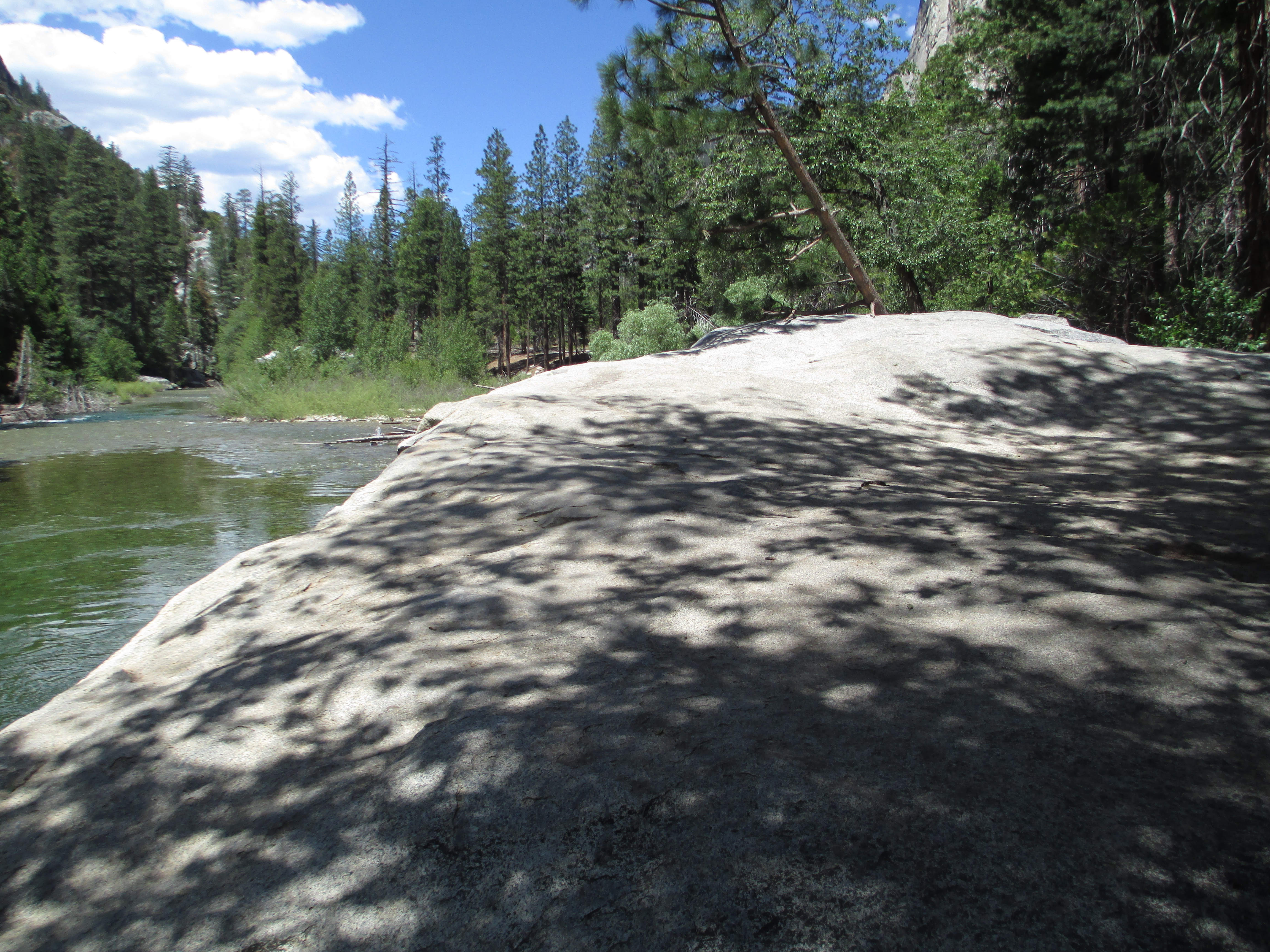
Kings Canyon National Park has been billed as a smaller Yosemite. While it lacks the famous highlights people expect to see in the larger park, it has a similar feel and is much less crowded. John Muir even blessed the place by designating a large granite slab, located alongside the south fork of the Kings River, as his personal pulpit. He was known to deliver lectures about environmental concerns from this rock, and the scene probably hasn’t changed much since then. Visitors to Kings Canyon can also enjoy easy access to the adjoining Sequoia National Park.

IMG_0863

As soon as school got out, I hit the road with another community college instructor, Pam Kersey, only to head for the Sierras. We were prepared for comfortable tent camping—we certainly didn’t skimp on the food—and the urban sprawl of Southern California quickly fell behind us. Pam was particularly eager to camp near the Kings River, because she once learned the art of camping there. In those days she was a single mother of four young children, and she had few camping skills. She’s now remarried (her children are all grown up), and she’s long since become a seasoned camper, not to mention a backpacker.

I know these things about Pam, because during our trip we exchanged stories about how we each became competent campers. From there we moved into the benefits of camping and why we loved it so much. Indeed, the great thing about camping is that it is easy to engage in meandering conversations—the sort of discussion one rarely has time for during the academic year.

We had time for other things, too. Pam read. I started two poems on trees. We both stared at the river.

I began to learn the art of camping at the age of 4 or 5. My family often frequented campgrounds in the Sierra Nevada foothills, the Mendocino area, Lassen Volcanic National Park, and Southern Oregon. We owned a canvas tent weighing at least fifty pounds—it could have doubled as a small house. As a youngster, I quickly became fond of the Coleman brand. We owned Coleman sleeping bags, a Coleman cooler, a Coleman lantern that hummed loudly until my parents finally came to bed, and a Coleman stove. For this trip I tossed my own self-starting Coleman two-burner into Pam’s Subaru, and it served us well.

photo-1Pam was dead set on finding a campsite right next to the river so that we could fall asleep to the sound of roaring waters. She assured me we’d have no trouble finding a spot, as there are four campgrounds near the Cedar Grove Visitor Center (the campsites in this area are offered on a first come/first served basis). We arrived to find her top pick, Sentinel Campground, closed. So we ended up circling the other three campgrounds—this after some 8 hours of car travel—until we finally agreed on the perfect site.

Our first day of hiking proved to be a sampler. We tramped around the Zumwalt Meadow before checking out Muir’s Rock. Then we doubled back along the other side of the meadow—and through the forest—to take in Roaring River Falls. I have hiked the loop linking the High Sierra Camps in Yosemite, and this is definitely an easier way to enjoy a similar landscape.

Unfortunately, we faced unseasonably hot temperatures. By the end of the day, lovely though it was, both of us were privately wondering if we should finish up our trip in Sequoia National Park, which we knew was bound to be cooler, as it is several thousand feet higher. And while we had a rigorous 8.5 mile round-trip hike to Mist Falls planned for the next day, an afternoon of splashing in Hume Lake was quickly becoming the more alluring substitute. It was during one of our meandering conversations that we finally confessed these thoughts to each other.

Image

The next morning found us packing in preparation for the big trees, and we did not look back. We enjoyed our afternoon by the lake (thoroughly), and the following day we embarked on a rigorous hike in Redwood Canyon, where we padded through several Sequoia stands (free of fences and plaques) on a trail we shared with few others at the peak of the wildflower season. This setting is roughly 2 ½ hours from Fresno, yet as we walked beneath those towing giants it was impossible to imagine the valley below (wilting in 109 degree heat).

Facing the Singing-Acting-Dancing Monkey

Years ago book critic Michael Upchurch told me how it was virtually impossible to keep up with all of the noteworthy books being published, because, as he put it, “we are living through a renaissance.” I immediately wondered which titles would still be around some five hundred years from now, when our renaissance is being taught to undergraduates.

Creative America does appear to be alive and well. The myriad workshops available to writers, actors, musicians, not to mention various blends of these categories, is noticeably lush. I recently took a workshop with Ann Randolph involving both writing and improvisation (in an earlier post I mistakenly called it a performance poetry workshop).

Ann Randolph is a self-starter who has produced, performed in, and written her own one-woman shows. I was privileged to see her multifaceted production of Loveland at Rhythmix Cultural Works in Alameda, California, the night before our workshop began. Her portrayal of Frannie Potts—who is trying to come to terms with the life and death of her mother—is funny, painful, bold, and skillfully executed. By the way, Randolph also plays Frannie’s mother, as well as the other characters in Frannie’s life, and quite a cast it is. She flips between these characters with remarkable speed and somehow manages to be “in character,” no matter which character it is.

While Randolph exudes the sort of talent that could make the aspiring writer and/or performer want to curl into fetal position, she checks it at the door and moves into an unassuming stance before she guides other artists. She’s actually gotten into the habit of teaching a writing workshop to audience members right after her 90-minute show, which must feel like a marathon.

During our two-day Write Your Life workshop, which was offered through 27 Powers (www.27powers.org), I zipped through all of the writing exercises without batting an eye. The improvisation activities were another matter. Not only did some negative feelings surface around the use of role-playing in the workplace (former staff development workshops), a much younger artist immediately began to kick and scream. I pretty much bowled my way though each exercise with resistance set on high. By the end of the first day I had “been there done that.” If I hadn’t been participating with a friend, I might have passed on day two.

But that’s when everything gelled.

Voice Break describes how I began singing in my twenties, only to hit a wall. During those days I also studied acting and dance. While I did receive the most encouraging feedback on my singing, I had some vague dream about how I might do it all. In the end, I threw in the towel on the performing arts world altogether and began to fulfill my true dream, which was to become a writer (like so many other people in this literary renaissance). I dismissed those performing arts classes as a phase, as therapy, as the sort of activity I needed to delve into in order to find myself.

During the workshop, I turned out pieces centered on how I’d written these explorations off. My subject matter was clearly driven by the improvisation exercises, which I was not expecting to face. I found myself writing about all of those feelings of failure that once arose in me when I didn’t hit the mark. I wrote about the awkward instrument I used to work with, the frozen body that wouldn’t move the way I wanted, wouldn’t allow my true voice to come through.

Micro-movements are the building blocks of character—the little nuances, the fears we express in nervous laughter. They are hard to discover when you can’t find your body, when you shoulders are up in your ears and you can’t feel your breath, when you feel pressured to be clever, look funny, and come up with that brilliant flick of the hand in time with the killer line you have just made up.

I’d thought I’d come to terms with this period, especially as I watched my confidence as a writer slowly begin to grow. In those early years of my writing life, I’d been particularly taken by Natalie Goldberg’s discussion of the monkey mind, the critical inner monologue that runs as the artist tries to work. I finally had an effective way of defining this creature and nailing her down. I learned how to get out of my own way and write.

Yet as I stood before a fellow player on the stage—as I stood before the rest of the retreatants in the workshop trying to be good—it was clear a different monkey had never completely left me. There she was chattering away, reminding me of how I’d blown it.

This surprised me. Like I noted, I’d written off my involvement in the performing arts as a learning experience, which remains a fair assessment. So I hadn’t expected this material to be so fierce. I hadn’t expected the feelings to be so immediate. As a writer, I rarely beat up on myself anymore. I just try to see what works and what doesn’t. Yet as a performer, I was quick to dive right back into the sort of habitual thinking that can only sabotage one’s work.

In the end, I was forced to consider how I’d ignored the aspiration that once motivated me to try to perform in the first place. As the pile of pieces centered on this era of my life grew, I found myself facing what I had so firmly squelched—the fact that my desire to perform had been real, not just a therapy exercise.

Yet if we are currently living through a literary renaissance, we are truly experiencing a performing arts renaissance. It’s daunting to get up on the stage in the midst of all of that talent. Besides, I expect I only want to make peace with singing-acting-dancing monkey. While I do sing in a choir these days, writing is surely enough creative activity for one voice.

Poem in Van Gogh’s Ear

Van Gogh’s Ear has just published “Earth Day,” a poem originally featured in The Ballad of the New Carissa and Other Poems.

The Life That Waits

Sometimes your life waits for you somewhere without your knowledge. Like my former boyfriend, David Kirchner, who still happens to be a friend. We met in the Anza Borrego Desert. OLYMPUS DIGITAL CAMERAEventually we discovered that we’d attended the same elementary school in Davis, California. Actually, I attended Valley Oak Elementary School, and he went to East Davis Elementary School. We quickly ascertained, however, it was the very same school. By the time I was three, his family had moved to La Jolla (I was still facing the big oak tree in the kindergarten playground). Still, I wondered if his parents had ever run into my parents during the early sixties.

IMG_1497

As my life turned out to be firmly rooted in the Pacific Northwest before I came of age, I had no intention of ever leaving. Yet twelve and half years ago I found myself heading south to work with the late Zen teacher Charlotte Joko Beck. I didn’t know anyone else in San Diego, but once I arrived, I ended up encountering a bunch of characters that were vaguely recognizable.

Take Mai Lon Gittelsohn. She also could have walked past my parents—though in the Bay Area during the fifties. Her husband Mark did meet my father back then, in one of the UC Berkeley libraries. In fact, he remembers half the staff my father eventually worked with in the UC Davis library (my father left them around 1975). The thing is I met Mai Lon in Forest Grove, Oregon. We both signed up for the low-residency MFA program at Pacific University. Low-residency means students can live wherever they want and show up in Oregon twice a year for ten days. Which is what we did. Then we’d fly home to San Diego.

IMG_0076

Mai Lon is old enough to be my mother. She does have a daughter exactly my age. She and her husband, Mark, used to socialize with one of the people who helped to hire me as a community college librarian in the San Diego area some twelve and a half years ago. His name is Larry Sherwood. I guess he and his wife, Virginia, and Mark and Mai Lon used to hang out together before I met any of them. My friend Patricia Santana remembers Mark from her UCSD days. She was employeed as a student worker in the library, where he worked as a librarian (she also helped to hire me, though I’d never met her before the interview). Virginia Sherwood worked in the UCSD Library. David’s mother—Florence—once worked for UCSD, though not in the library. For that matter, so did Joko Beck.

At 79 Mai Lon was the oldest student in my graduating class at Pacific University (class of 2012). She’s just turned 80, and she’s hoping to publish a book of poetry about her Chinese American family. We recently figured out that her grandfather was living in Red Bluff around the same time my great-grandmother was living in Redding. For the record, my great-grandmother ended up in the Sierra Nevada foothills, and Mai Lon’s family ended up in Oakland. And I ended up in the Pacific Northwest and Mai Lon ended up in Del Mar.

This weekend Mai Lon and I will be heading off to Alameda to take a performance poetry workshop with Ann Randolph. I expect we will have plenty to share.

The Post-MFA Doldrums

I waffled for years over the MFA possibility before I found myself checking into the dorms. With three novel manuscripts beyond the first draft stage under my belt, I knew I was disciplined enough to stick to a writing schedule, even as I remained committed to my official career. No, I wasn’t worried about discipline. In my daily life I was struggling with a sense of isolation as I interacted with educators and librarians, but very few writers. The MFA program offered through Pacific University provided the writing nest I craved, not to mention another genre to work on, and I didn’t look back.

Not only did a new pile of poems continue to grow on my computer, one instructor encouraged me to put a musical cover on Voice Break and publish it. While he was no doubt thinking of a chapbook, I decided to take the plunge with CreateSpace in order to produce a print-on-demand paperback. This process was so sustaining, I followed suit with a book that included “The Ballad of the New Carissa,” as I figured a traditional poem running close to 3000 words would be a challenging to place.

Now I’m in the post-MFA doldrums, trying to feed my writing life on my own once more, not to mention get work out there. Fortunately, one of my fellow students lives in the area, and we’ve started our own writing group. And I finally stepped foot into the San Diego Writers, Ink facility, an edgy loft in downtown San Diego where workshops are regularly conducted (I am currently taking a poetry class from Steve Kowit).

While I’ve had plenty of poems tucked away for some time now, I’d been avoiding the publishing process, because I was already burnt out from trying to publish my two of my novels. Yet after filing my diploma away, I figured my poetry writing degree would go to waste if I didn’t try to place some of my work. I just wasn’t completely sure of how to go about it.

I did get lucky in the beginning, so I decided to tackle the whole process methodically. I took a stab at entering as many contests as I could find (no wins yet). Then I decided to submit almost every viable poem I’d written to one journal or another. I quickly learned that I was indeed lucky with those first submissions. As the rejections came pouring in, I decided I should probably just submit my best poems (if only I could determine which ones those were). A bunch of these pieces are currently “pending response,” and many have already been rejected.

Duotrope, an online writing resource, has become indispensible in this whole process. Their submissions tracker, which costs $50 a year, allows writers to easily organize submissions in an online database. This service also provides invaluable, up-to-date, information on literary publications. With a few keystrokes, a writer can quickly determine where they’ve sent any given piece, as well as figure out how long a particular publication has held it.

Their weekly poetry newsletter has inspired me to try yet a third approach: to focus on journals soliciting themed submissions. Today, for example, I submitted poems to publications looking for poetry on Harbors & Harbor Towns, Rebirth, Sound, and finally, Trash and Treasure. We’ll see if this method increases my odds.

As for the novels, well… I’ve got to get back to them. When I entered the MFA program, I already possessed several file folders full of rejections on the first two. I was definitely fishing for a reason to continue as I focused on the joy of poetry writing in graduate school.

I’ve now had ample time to lick my wounds, so I figured it couldn’t hurt to enter my second novel manuscript into some viable young adult novel contests (it does feel good to get back to this). IMHO, my first novel needs to be completely revamped (on the to-do list). And the last one was never finished (also on the to-do list).

Ah, discipline.

It’s been almost a year since I’ve graduated from Pacific University, and I continue to feel a certain momentum egging on my writing life. Let’s see if it holds up.

The Importance of Literary Friendships

Some years ago I took an undergraduate class on poetry writing from Marilyn Chin at San Diego State University. At one point during the semester she extolled the virtues of having literary friendships, and we actually met one of her literary friends (whose name now escapes me). I was able to nod knowingly, as I’ve enjoyed a number of meaningful literary connections over the years. These are people with whom I’ve talked “writing,” exchanged manuscripts, celebrated successes, and—most of the time—commiserated.

Patricia Santana

Today I highlight one of these writers, Patricia Santana, who has played this role in my life more recently. We’ve had many lunch dates focused on writing, and we once exchanged second novel manuscripts (hers – Ghosts of El Grullo – has been published; mine hasn’t). To be sure, I don’t think I’d have much of a place in San Diego’s literary community without her influence. One time she invited a large group of local writers to her home for dinner, and I was lucky enough to be included.

What has most touched me about Patricia, however, is the way she has supported me as I’ve brought out two volumes of poetry. Not only have I received encouraging feedback from her, she recently—of her own volition—hosted a reading for me and badgered our fellow colleagues to attend.

So I’d like to take this opportunity to emphasize her work, especially since she is currently writing a new novel, one that is sure to come out in a year or two. You can learn all about Patricia on her website: http://patriciasantana.net/

Image,

Book Trailer

Video

I dipped a toe in and created a book trailer for The Ballad of the New Carissa and Other Poems.

Check out San Diego’s own writers!

SDPL1

Some memories hold firm even as the context that once cradled them fades away. They rise on occasion, like a high definition video, and the viewer wonders about all she has forgotten. When I attended the 47th Annual Local Author Exhibit, hosted by the San Diego Public Library, the following memory surfaced.

It is 1988 and I am riding the escalator in Seattle’s downtown public library, which seems most cosmopolitan to this young woman who once found Eugene large in comparison to the places she had been. I am wearing pumps, hose, and a dress that looks like a business suit. It is a dress code I am expecting to adopt once I land my first professional job. As the steps of the escalator move toward the third floor, my nervousness peaks. I am about to face an interview that will eventually pave my way into Seattle.

SDPL2

I spent over twenty years working in four public libraries in four different cities before moving on to higher education. So maybe the old downtown library in San Diego, slated to be abandoned now that a new building is being prepared for its grand opening this summer, brought on the nostalgia. It is certainly reminiscent of the Seattle library I once knew before it was leveled so a spiffier building could rise in its place. Or maybe I’ve just lived through another high definition video, one that will eventually begin to play on demand. That day I rode the escalator felt like a new beginning—and so did this one.

To be sure, my former colleagues in Seattle would have envied such a program, which was hosted for more than 400 writers who live and write in the greater San Diego area. Our books were placed on display on the main floor and will remain so throughout the month of February. Yes, we were treated to music, hor dourves, as well as a good inspirational speech by Judy Reeves, founder of San Diego Writer’s Ink, “the city’s premier writing center which anchors the literary community in the city and is a proud neighbor of the New Central Library.” Best of all, to me anyway, we were able to share the festivities with the library workers who organized the event on our behalf. SDPL4

Kudos to the San Diego Public Library!