I’m pleased to announce my poem, “Moonwatch,” has been published in the Objects in the Mirror edition of Caesura Online. My poem “Ocean of Stars,” has been published in the print edition.

I’m pleased to announce my poem, “Moonwatch,” has been published in the Objects in the Mirror edition of Caesura Online. My poem “Ocean of Stars,” has been published in the print edition.

I’ve had a number of conversations with other writers focused on how those with book deals are charged with promoting their own work, including writers who are lucky enough to publish with “The Big 5.” We sigh and yearn for the support authors of yore used to receive (big ones, anyway). Then we proceed to roll up our sleeves. It helps that I’ve been through this process with my other indie titles. Yet I’ve been noticing how it is essential to keep a finger on the pulse of things, because the mechanisms for literary PR seem to shift at regular intervals. In preparation, I’ve combed through lists of ideas, trying to decide what will work best for my situation. Now it’s time to get started!
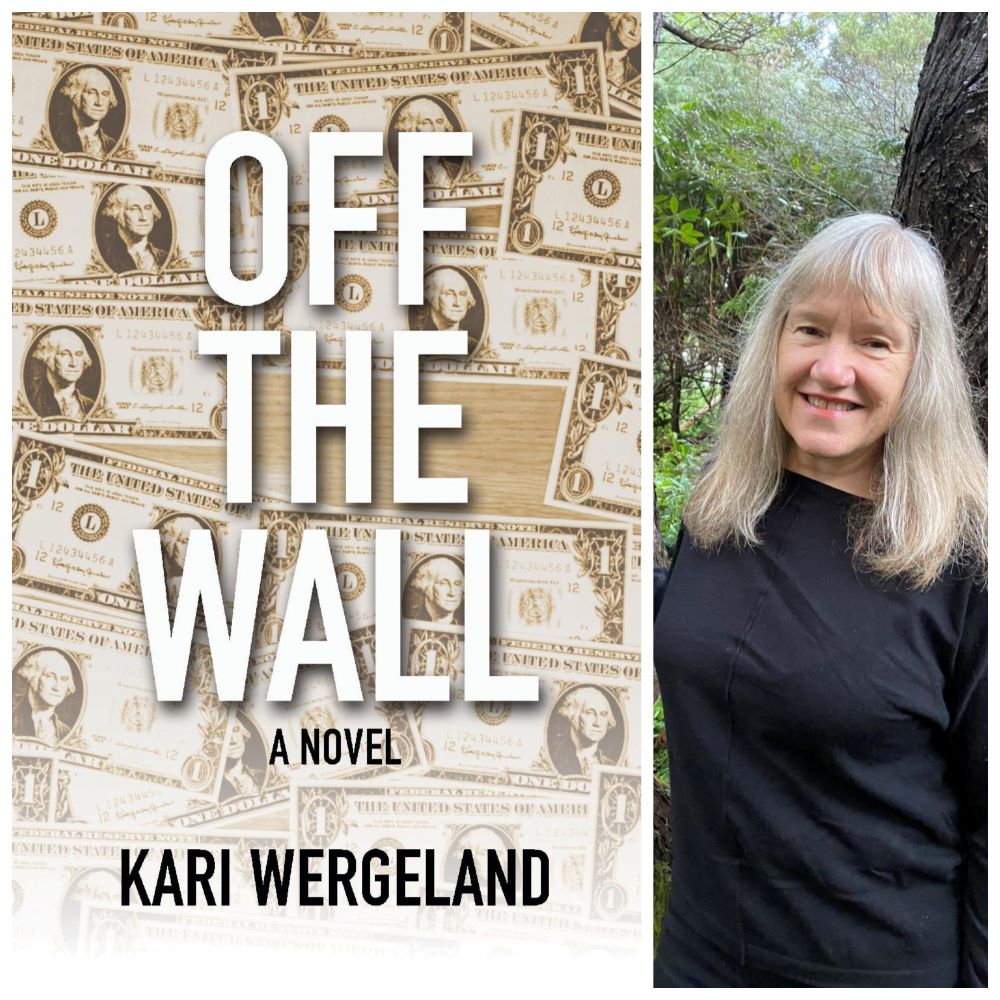
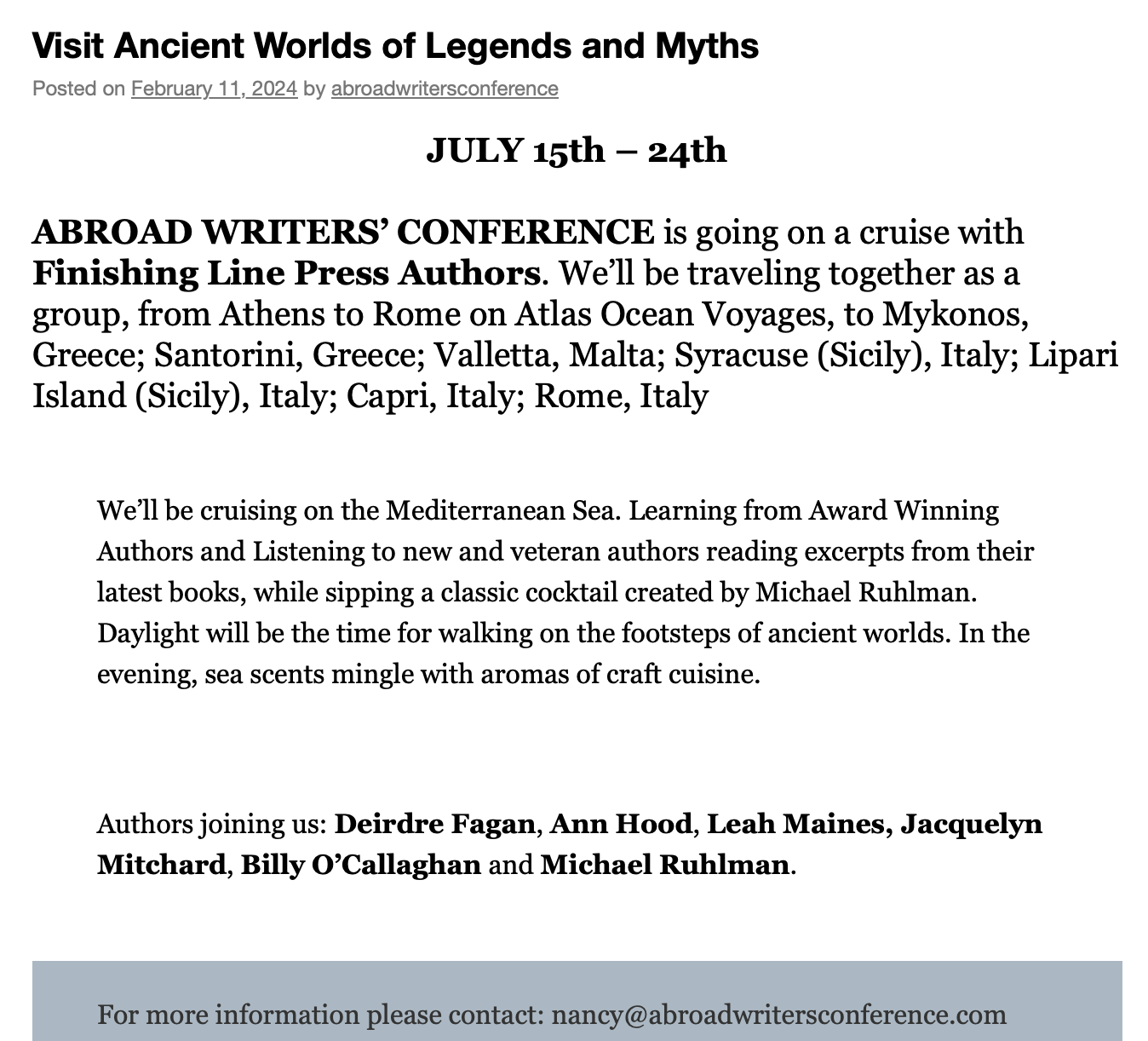
I’m pleased to announce Finishing Line Press has placed my forthcoming novella, Off the Wall, into the advance order phase of their publishing process.
“Kari Wergeland’s novella OFF THE WALL is a rich and nuanced portrayal of a young woman struggling to find her place in the world. I was immediately drawn in by Sadie, the intriguing protagonist, in this tale of redemption and healing, of love and family beautifully rendered!”
–Patricia Santana, author of Motorcycle Ride on the Sea of Tranquility
Nothing better than to read a good story about a smart girl who sets off to be independent, and along the way grows into a strong woman with dreams and aspirations. Kari Wergeland brilliantly creates a young Sadie who has many obstacles and road blocks in her way, but that never stops her from inspiring us with her determination and honesty. A story that will make all readers get up and follow their own journey.
–Amy Wallen, amywallen.com, Author, Editor, & Baker, How to Write a Novel in 20 Pies: Sweet & Savory Secrets to Survive the Writing Life
Order online at https://www.finishinglinepress.com/product/off-the-wall-by-kari-wergeland/.
Or order your copy of this new novella today at the discounted advance sales rate by sending $22.99 plus shipping (check or money order made out to “Finishing Line Press”) to the address below before AUGUST 25, 2023.
FINISHING LINE PRESS
POST OFFICE BOX
1626 GEORGETOWN, KY 40324
Credit card orders will be processed through PayPal. Shipping is only $3.49 per copy.
After publication, the retail price will increase to $24.99, so order your copy now. Advance sales help the publisher determine how well this book might do once it is released.
ADVANCE ORDER SHIPS OCTOBER 27, 2023
Check out this Off the Wall teaser on my Pinterest page.

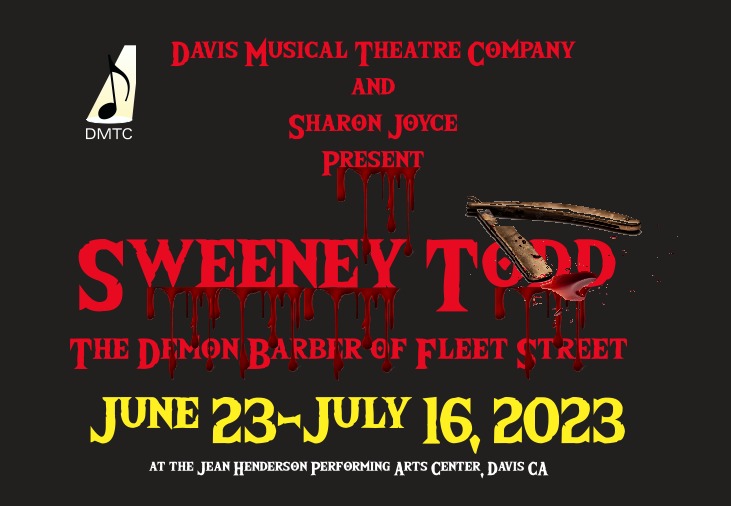
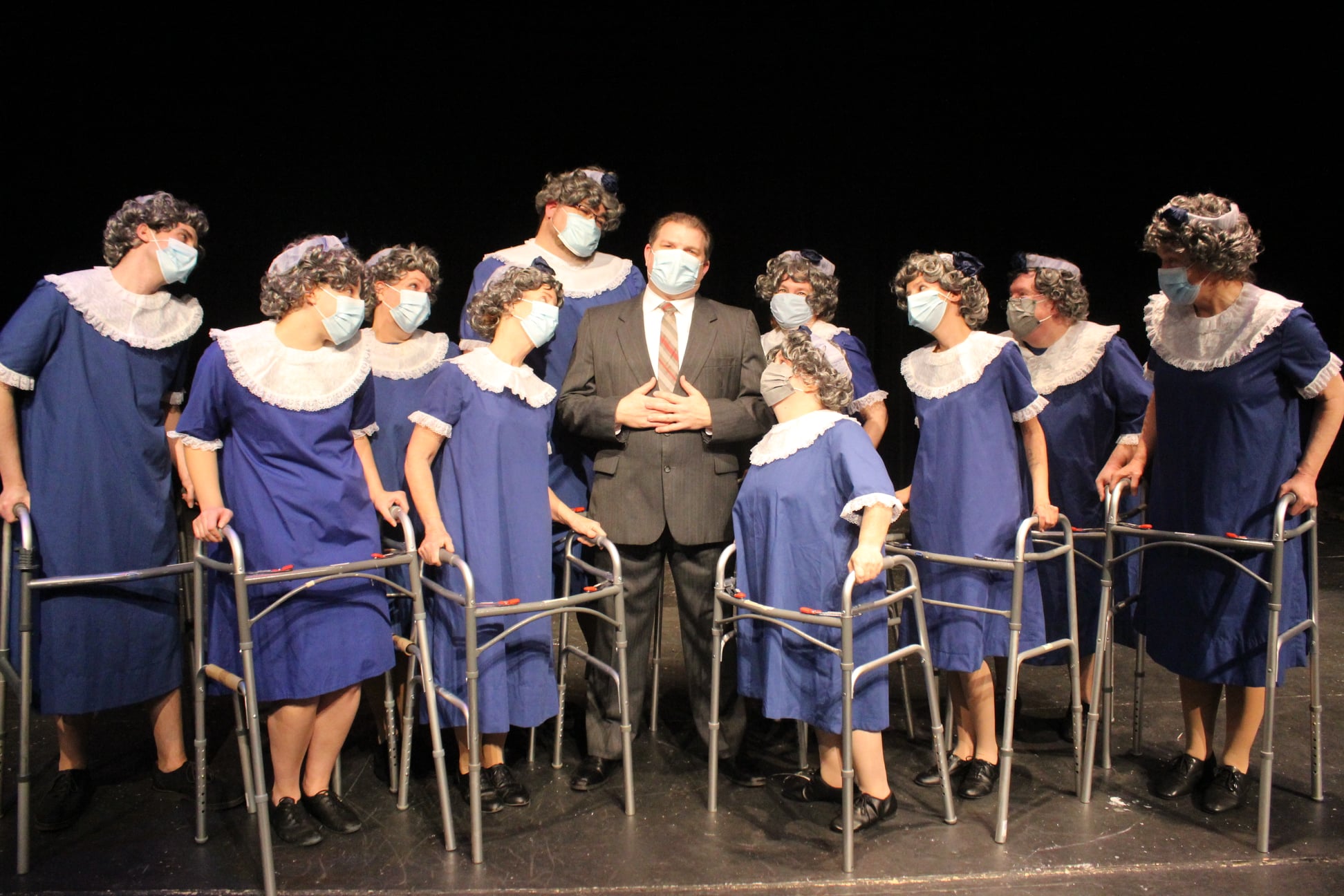
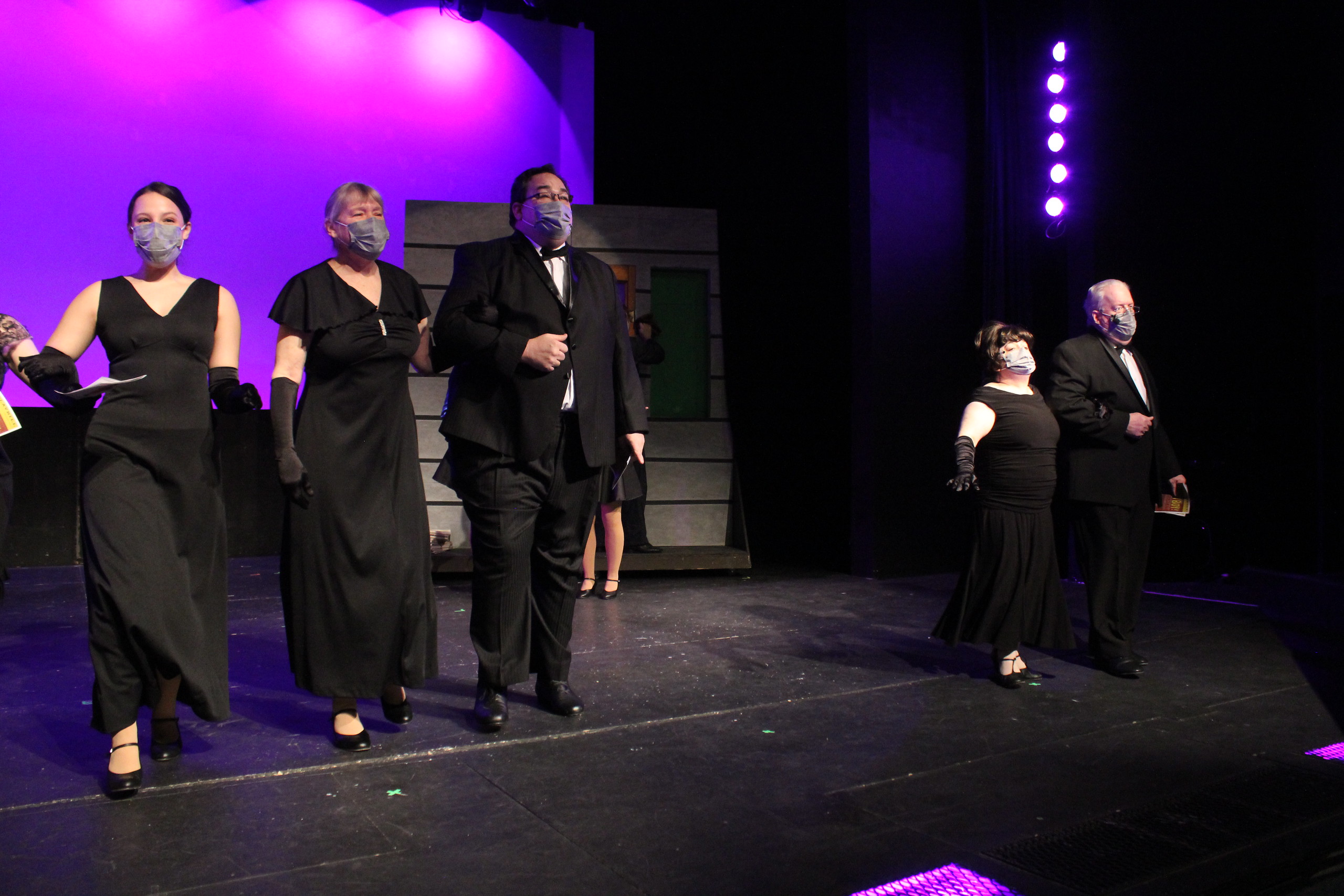
The writing life tends to be one big case of hurry up and wait. I’m still looking for that agent. At least I have one novel in the works. Finishing Line Press will put Off the Wall into the preordering phase on June 26th. But I won’t see the galley until the end of the summer and the book won’t become available till October (if all goes well). Meanwhile, I’m spending time memorizing music and blocking for Sweeney Todd. As the director, Steve Isaacson says, the ensemble has a lot of work to do. The London citizens in this show act as a Greek chorus, commenting on the tragedy at regular intervals.

I fell in love with dance while I was an undergraduate at the University of Oregon. As I knocked out a degree in English – after changing my major several times – I became an adult new dancer, sampling modern, jazz, and ballet in Oregon’s dance program. I also joined an audience of dance aficionados and have loved the art form ever since. Though when my library career pulled me into the fray, my focus went to other things.
Now that I’m living on the other end of my career, I’m finding myself taking in more dance concerts. Last Friday, for example, I was captivated by Sacramento Ballet’s wonderful production of Swan Lake. As I sat amid a sizable audience, I felt the twenty-something version of me perking up. That old passion is still there. I no longer study dance, though I’m currently waitlisted to join a second wind dance class taught by Pamela Trokanski. I could use some weight-bearing exercise to ward off the onset of osteoporosis, which can be caused by the cancer drug I continue to take.
Speaking of Pamela Trokanski, she’s directing a show this weekend, the Davis Dance Project: Art in 4 Dimensions. Like everything else, this annual event went dark during the pandemic. Trokanski has gathered her dance company, along with local musicians, visual artists, and poets (I happen to be one), to create pieces that are an amalgam of all these art forms. Trokanski kicks off the performance with a useful review of the choreographer’s palette in her lecture demonstration. Nice pieces follow, showcasing the work of Parto Aram, Analisa Bevan, Robin Lee Carlson, Joan Jarvis, Binuta Sudhakaran, Hank Lawson, Meri Superak, Ann Dragich, Erin Dunning, Taylor Herrera, Tase’, Pamela Trokanski, Allegra Silberstein, Kari Wergeland, Skye Falyn, Jack Collins, Sterling Anderson, and Lamondo Hill. You’ll have to attend to see how all of these voices fit together!
Saturday, February 25 @ 7:00 pm
Sunday, February 26 @ 2:00 pm
Louise H. Kellogg Memorial Theater
Pamela Trokanski Dance Workshop
2720 Del Rio Pl
Davis, California

This year I managed to post one blog piece, kicking off 2022. The rest of the year slid past me, though that doesn’t mean I wasn’t using my voice. I was busy with agent queries, a bit of poetry writing, and revisions on my set of linked short stories. Yet none of these endeavors insisted on a blog post. I’m remembering how I started this blog in 2012 to explore the idea of voice and vocal problems. In an attempt to round out not only the past year, but also the last decade, I will offer an update on the state of my voice.
I hit a milestone when Finishing Line Press accepted my novella, Off the Wall, last September. While I’ve had a few short stories published, Off the Wall will be my first full-length paperback (if you discount my self-published collection of poetry). The novella stars Sadie Taube, the daughter of a deceased heroin addict. She’s living on Bainbridge Island, Washington, with her aunt and uncle in their big ass house. While they treat her all right, she’s not exactly their daughter. She’s been working in a diner and saving every penny. The restaurant is warm and friendly, decorated with the dollar bills customers have left behind. When Sadie turns 18, her boss Bev asks her to stay after work so they can celebrate. Bev doesn’t know she has a plan brewing, one focused on the Coast Starlight. Sadie is gonna get on that train and head to California. Yet during this last hurrah she finds reason to track down a little extra money (when Bev isn’t looking). Off the Wall is due out next fall.
What I like about poetry writing is the way commercial aspects do not play into the publishing process all that much. I can tinker with work and get it out there. But I can’t expect a lot of recompense. So I don’t. Writing poetry allows me to experience the joy of writing without feeling pressures focused on agents and editors, or the tough publishing market. Feeling that joy has its own reward. Once a poem is out in the world, it claims its own destiny. It can live or die, as necessary.
And yes, I’m still singing. During the first year of the pandemic, I connected with a voice teacher on the Oregon Coast who was willing to work with me either on her porch (as she guided and accompanied me through the window), as well as via FaceTime (during times when I was working as a librarian in California). My teacher uses the Joseph Klein technique, which initially felt like a dubious challenge as it differed from anything I’d done before. Yet this approach has helped me fix a number of problems. For example, evening my upper register with my lower register has been a major snafu for me since day one. We are now in our third year together, and I continue to be amazed at my teacher’s ability to push me to the next step. This fall she assigned “O cessate di piagarmi” by Alessandro Scarlatti, as well as “Nel cor più non mi sento” by Giovanni Paisiello. As I live in Davis, California, when school is in session, I’ve been trying to do my best with these pieces through FaceTime. I’m looking forward to my next in-person session with her so that she can truly assess my progress.
Finally, I haven’t stopped exercising my library voice, and I’m not talking about shushing people when I’m sitting on the reference desk. Community college librarians have been charged with the task of helping people work through the maze of misinformation, disinformation, and fake news. It takes work to develop the sort of critical thinking necessary to pinpoint quality sources. I stand ready to cheer on any student willing to deepen their information literacy skills. As an FYI, I will be teaching Library Research and Information Literacy online through Sacramento City College this spring (March 20 to May 12).
Happy New Year!

I was looking for a way to do something tangible in the community so I could begin to regain a sense of normalcy—something in person with other people around. When my friend Annie began pushing me to audition for a Davis Musical Theatre Company production last summer, I thought maybe this would do the trick. I could toss Zoom by the wayside for a bit. I had some selection. Under normal conditions, DMTC produces 11 musicals a year.
As Annie poured over her phone, I drove us down highway 101 alongside the Oregon Coast. She ticked off my choices: The Titanic, The Producers, Urinetown, and Evita. She noted they were performing in masks. Indeed, masks were required for anyone in the theater. They had a vaccination requirement. She would audition if she lived in Davis. Annie pointed this out as I silently pondered her lengthy resume of musical theater productions next to the one show my theoretical resume would list: Amahl and the Night Visitors.
Yet I had been taking advantage of the COVID fiasco to strengthen my vocal technique. I started working with a new voice teacher over a year ago. Chris and I continue to chip away at myriad issues. As Annie and I shot past rolling waves, I wondered if I should give DMTC a whirl, but I fretted it might be too soon to perform publicly, given the trauma of COVID. Besides, I’d been enjoying lessons focused on pure technique in lieu of preparation for a concert. The pressure was off. I could work at getting better and develop some muscle memory.
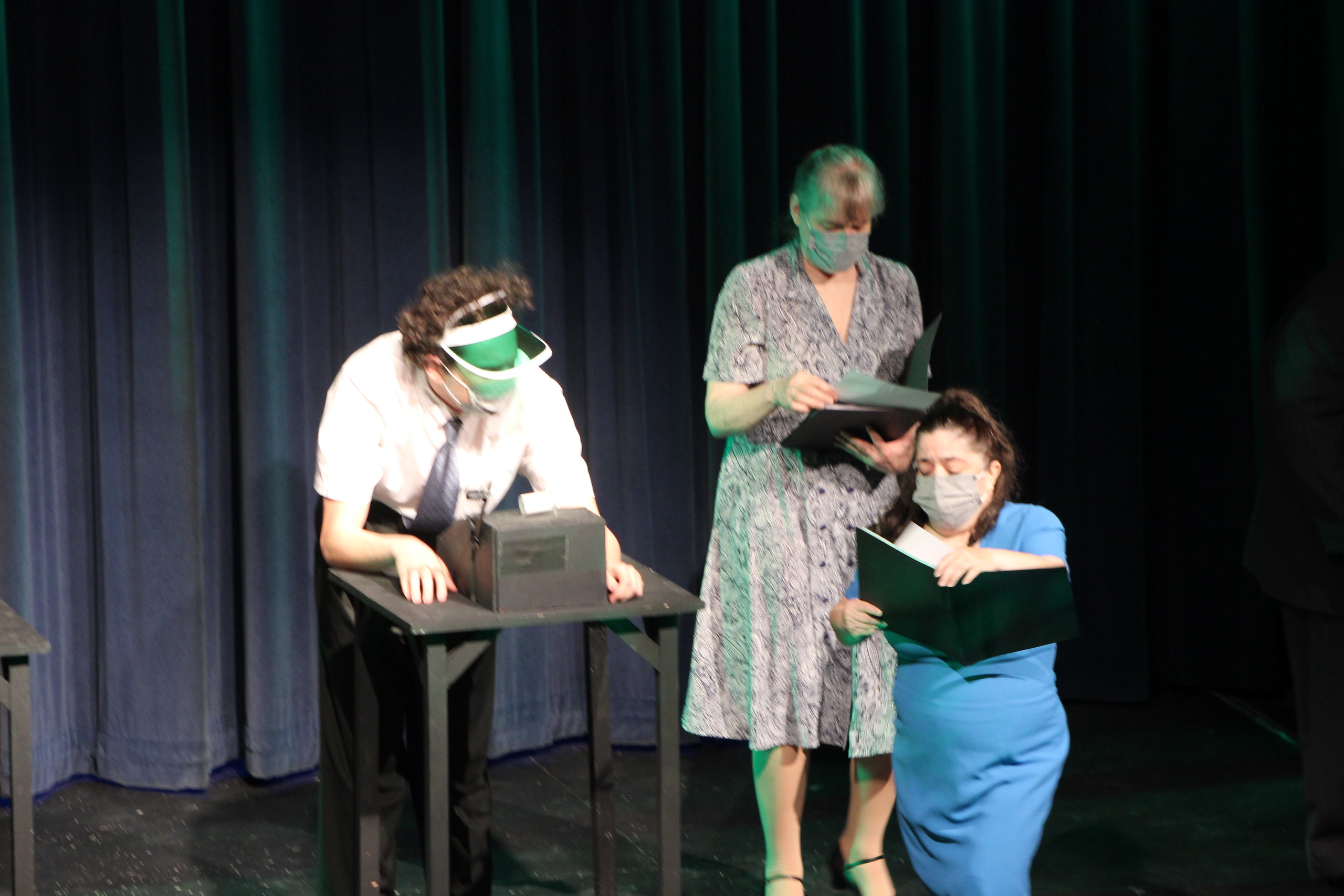
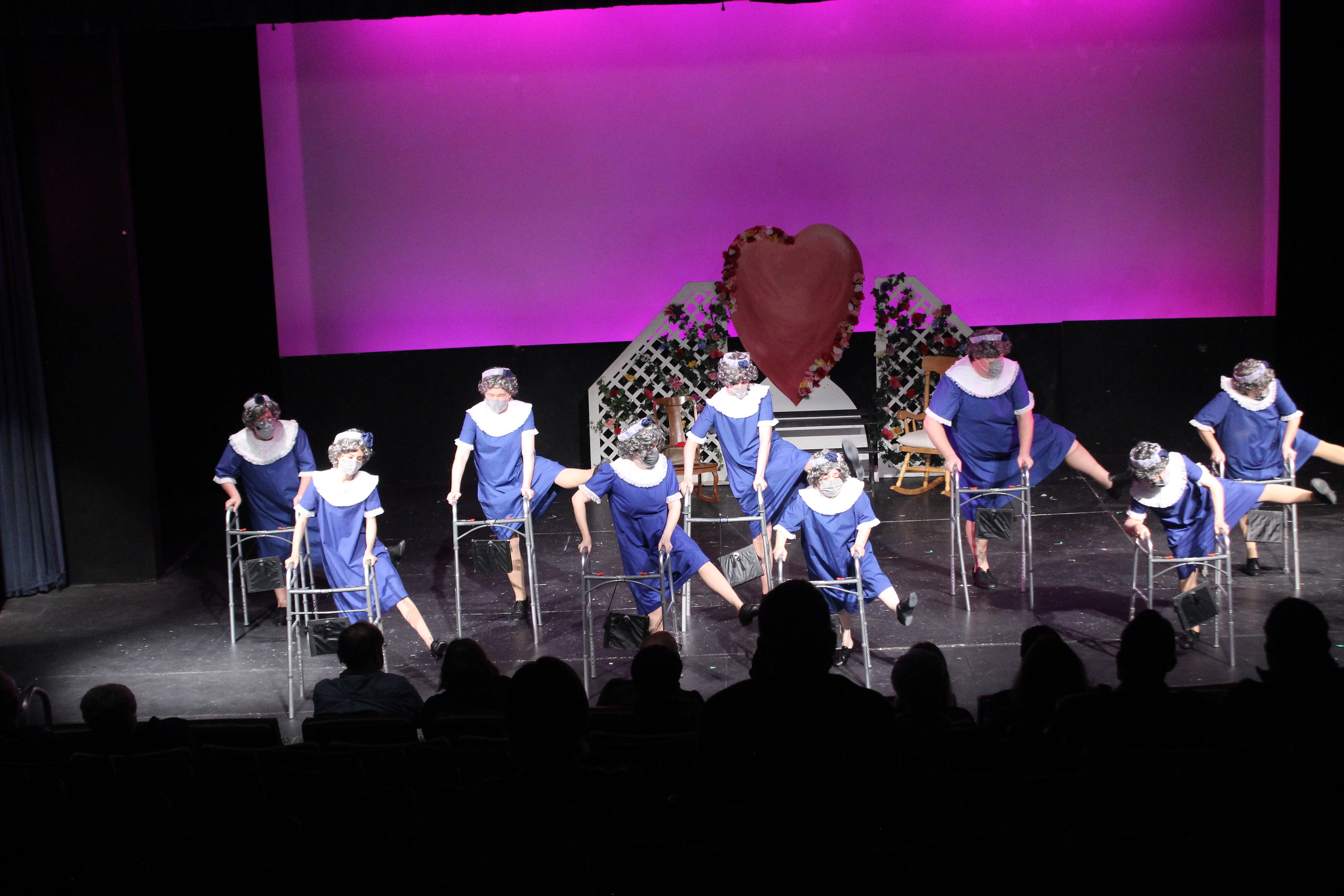
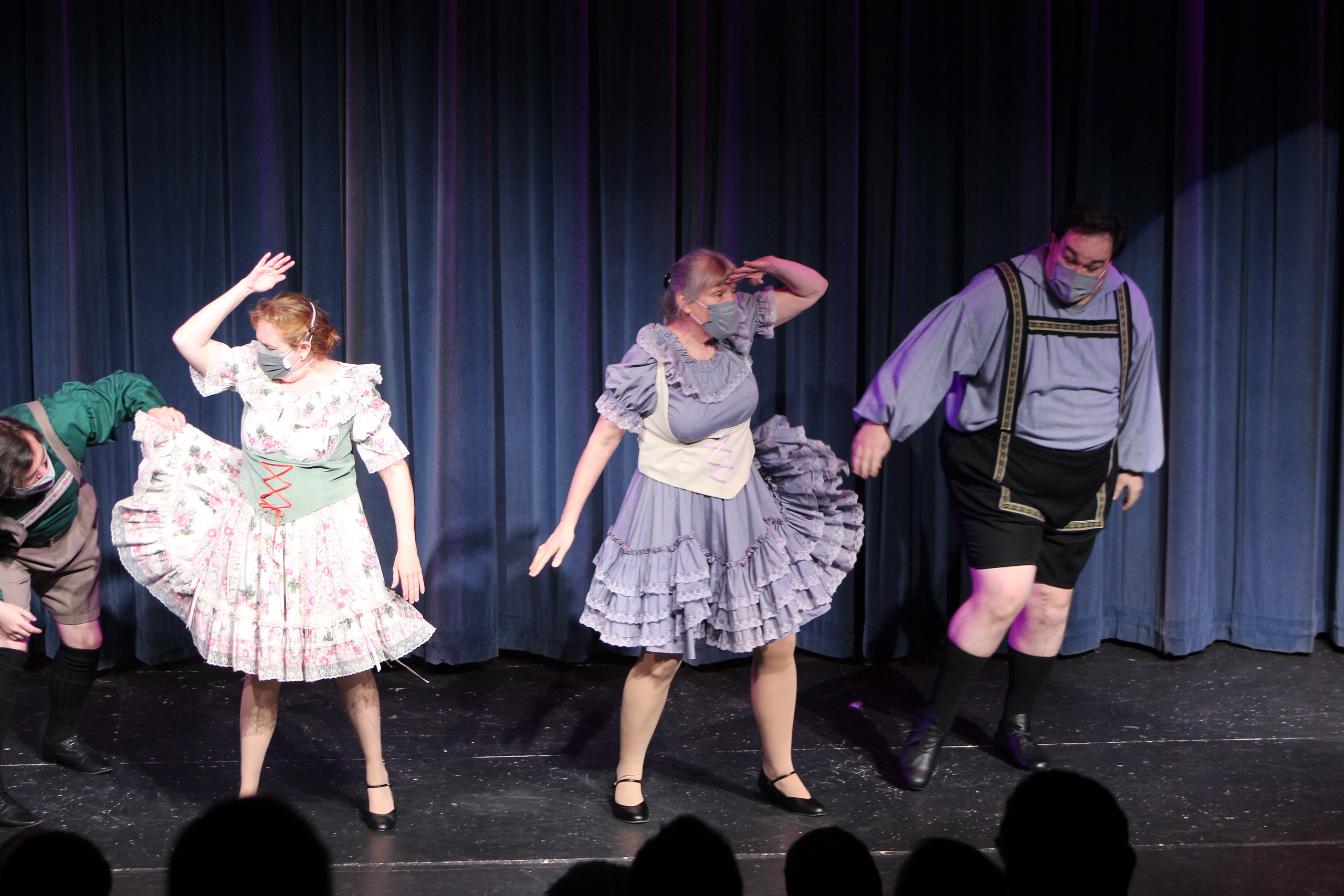
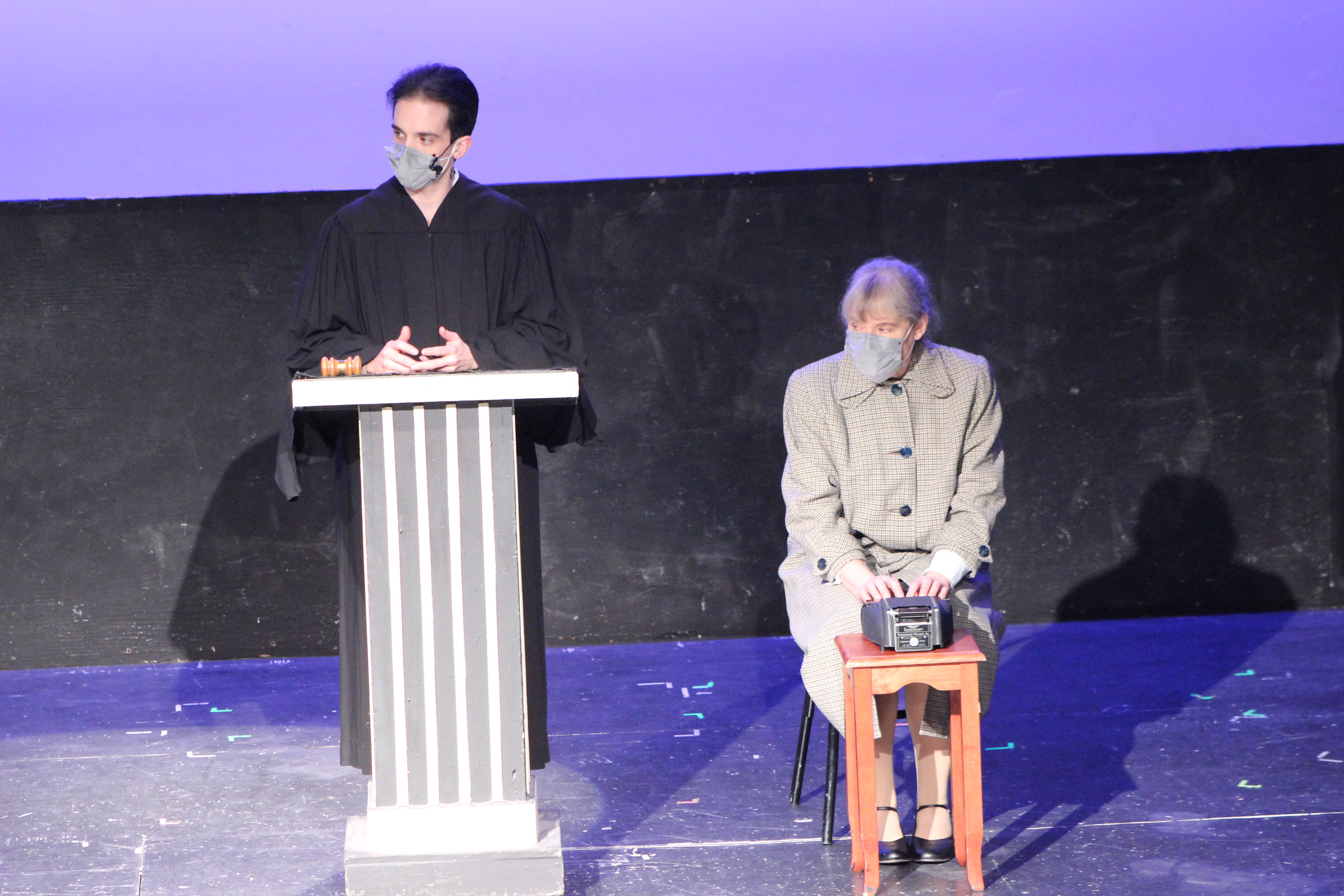
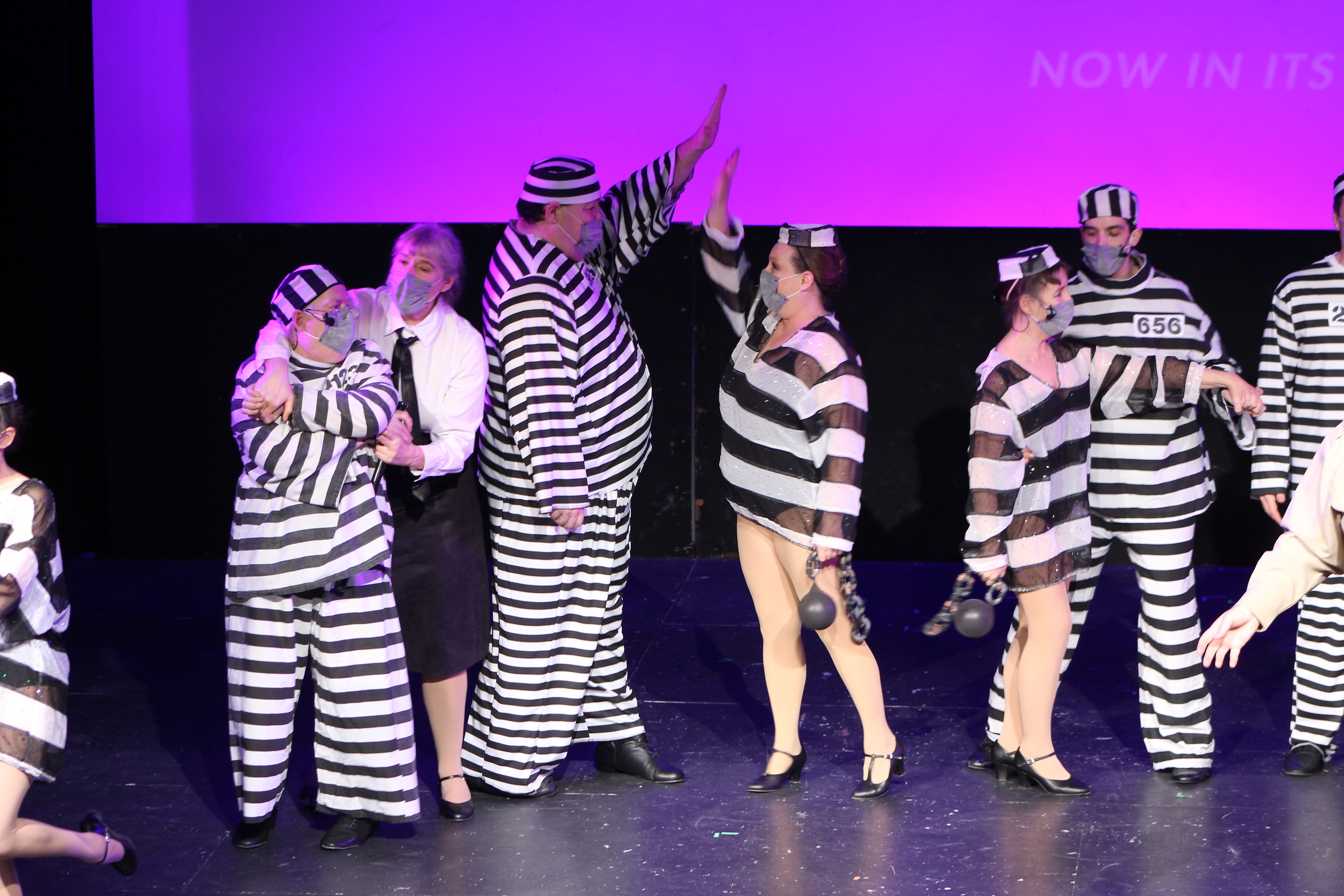
To make a longish story shorter, I decided to audition for The Producers. I was pleased to be cast as an ensemble member. We began rehearsals in November, before Omicron was announced. I quickly discovered my ensemble role in the show was a whole lot to organize. I was assigned nine costumes. I was asked to learn six dance numbers. I had three tiny acting parts—those were easy. We were expected to change our own sets. Of course, there was plenty of music to learn. I thought the masks would be a pain, and they sort of were. Though once I was forced to dive in, I rarely thought about my mask.

I watched my fear rise and fall as we moved closer to our first performance. So many things could go wrong on that stage. While I did not show up without dance training, it was training that had occurred during the 80s and early 90s. I was out of shape and not completely limber. I was quite a bit heavier. The year before, I’d thrown out my knee during a long hike. I worried the problem would crop up as I rehearsed. Stress arose over tracking down a pair of character shoes with heels that wouldn’t aggravate my plantar fasciitis. I found myself trying to keep up with younger dancers—some of whom were much younger. And this didn’t begin to cover my fears over hitting a wrong note or singing off pitch—or forgetting the words. As for COVID, I trekked over to Healthy Davis Together once a week to test for COVID.
But then I thought, what else is new? The last two years had been feeling like this. So many things could go wrong. We’ve all been mucking about on this earth weighed down by a pandemic, not to mention a whole host of other problems. We do our best to deal with what comes our way. Maybe that’s how things always are. Yet pandemic life feels heightened somehow, like being on stage.
Well, those theatrical curtains have been drawn and we now have three performances under our belts. For me, the first weekend was a quality-of-life experience. Period. On opening night, we stepped into a different dimension, and we put on a show. The audience members who braved COVID to attend responded with genuine enthusiasm. The exchange was complete. Who knows if we’ll get to finish the nine remaining performances? We don’t know.


Kari Wergeland

My new voice teacher has been insisting I work on sight-reading, a skill I never learned as a young person. While I have rudimentary ability in this area, I generally feel handicapped when I’m called to prepare for performance. I’ve survived a number of choir concerts, but it would be nice to read with more confidence. I appreciate my teacher’s willingness to be patient with this retiree (OK, semi-retired) as she works me through one sight-reading exercise after the next.
This week she suggested I break the song into little pieces. When I master one bar at a time, the sight-reading process becomes less daunting. I’m not sure I’ll ever be “literate,” but working on this in a methodical way is making it easier for me to interact with the literature. This is what my voice teacher calls individual songs.
I’m facing another hurdle, a “now or never” conundrum. I’ve got three novel manuscripts I believe are ready for publication: a middle grade mystery, a young adult novel, and a novel for adults (whether the third one is commercial fiction or literary fiction, I’m not sure). I’ve tried various approaches to get my work onto an editor’s desk. I’ve mailed manuscripts. I’ve emailed them. I’ve attended conferences and pitched to agents and editors in person. I haven’t come up completely empty. I’ve received a few nice notes from editors of major publishers on earlier drafts of the first two manuscripts, now significantly revised (the third has not yet been pitched). As an aside, I’ve been published in numerous literary journals and anthologies. My poetry chapbook was an Eric Hoffer Book Award category finalist. Yet success in novel writing has remained elusive. I’ve stopped believing I’ll ever find the person who sees reason to get behind my long prose voice.
As I face this impossible task, yet again, I’m considering my voice teacher’s recent advice, “Work on one bar at a time.” Set little goals and complete them—one after the next. My first goal is to polish my supporting documents—query letters and synopses. My second goal is to make a verbal pitch to two literary agents via Zoom at the Willamette Writers Conference. Once I check these boxes, I’ll put together a list of agents and shoot out a pile of queries via email. If I can keep up staccato pressure approach, maybe…
When I was facing my first chemo treatment at the beginning of April 2016, I intentionally wore a T-shirt celebrating the 50th anniversary of the Seattle World’s Fair. My friend Pam Kersey was with me that day, and as the infusion began, she offered to take my photo to mark the moment. I had no idea the picture would later be used to create the cover of my chapbook, Breast Cancer: A Poem in Five Acts (Finishing Line Press). This proved to be a nice surprise. Yet the reason I wore the T-shirt was to reiterate a vow I’d made days before: when I was all done with breast cancer treatment, I’d finish the novel I’d begun in 2002. It was a project I’d been viewing as an albatross. I was determined to tie up the loose strands of Kaleidoscopes, Viewmasters, and The Game of Life.
The story is focused on a 40-year-old, Rubieann Blankley, who begins to dissect the cultural divide in America. It opens with her ruminations sparked by the film It Happened at the World’s Fair, which she is viewing in the Seven Gables Theatre in Seattle. Yes, Rubieann Blankley was born on the day the fair opened.
Fast forward to August 2017. I rolled up to my Oregon Coast cabin after retiring early from Cuyamaca College. I planned to regroup while looking for adjunct librarian work in Northern California. First on my agenda was to drag out this 2002 manuscript, which had been languishing since 2008. This is not to say I hadn’t done any work on it. The draft I stored in 2008 ran some 350 pages. I’d meant to get back to it sooner, but I became sidetracked by poetry writing and other fiction projects. Meanwhile, the 2002 manuscript leered at me.
Six boxes of research materials awaited in my cabin, along with the manuscript. Or so I thought. As I sorted through each box, I was horrified to discover the manuscript was missing. Thus began an odyssey focused on my hunt for the manuscript (detailed in an essay I hope to place if the manuscript is ever sold). I did not solve the mystery of the missing manuscript until two years later when I was unpacking boxes in my new Davis, California, studio. I’d secured adjunct work with Los Rios Community College District and was beginning my second semester.
By the time my new district went into pandemic lockdown in March of 2020, I had a working draft of Kaleidoscopes, Viewmasters, and The Game of Life. I decided to call this project my COVID novel. I was facing months of solitude, and I needed something to do. Yet I’d changed considerably since 2008. I couldn’t completely recover my earlier vision. I spent time analyzing what I’d written during the early 2000s, adding notes and new passages. I completed a new draft by the end of June 2020. My story expanded to 480 pages.
Feedback was called for. Three people read and critiqued the book. While they delivered many good comments, I was disheartened to realize I’d need to revamp a crucial aspect of my original structure. To explain, I used two point of view schemes, which I applied to alternating strands of narrative. One was told with the use of an omniscient narrator who copped a tongue-in-cheek attitude. The other was constructed with a close third person POV. However, two of my three readers demanded I kill my mocking narrator. This suggestion was hard to accept. Not only was I attached to the said narrator. It meant I’d have to rewrite one third of the manuscript.
I’m proud to say I completed the manuscript on Thursday, May 6, 2021, nearly 19 years after I first started it. Needless to say, I am at a loss. Five years ago, I was receiving chemo treatments, most unhappily. I now have a manuscript built from aspects of the person I was in my early 40s and the person I have been during my late 50s. I know there is much to get through if I want to get the manuscript onto the desk of a simpatico editor. Still, I feel free.

The Pfizer vaccine clinched it for me. I’d been stir crazy in my 470-square-foot studio, so I used my Amtrak points to book a roundtrip ticket on the California Zephyr from Davis, CA, to Chicago for spring break. I got this idea after I noticed how Amtrak was advertising these little rooms as a great way to travel during the pandemic. They’ll bring you your food. Masks are enforced in the public areas. They’ve worked on their air filtration system. I spotted an ad with a person sitting with a laptop in a roomette, and the writer in me said, Yes! I’d been wrangling with a 450-page novel manuscript throughout the year of COVID and was ready to move into some concentrated work on the project. As the trip drew closer, I began to waffle—worrying I’d be making a huge mistake. Then California opened their vaccine list to educators, and I inadvertently received my doses in time for the trip.

I boarded the train feeling nervous, though I quickly settled into the routine. I could lock my door, shut the curtain, and remove my mask. I enjoyed a few hours of scenery. Then I pulled out my laptop. The pressure cooker that is a roomette on a long Amtrak journey proved to be no joke for me. I wrote for hours during my seven day trip (two nights on the rails, two nights in Chicago, and two nights on the rails). My level of focus ratcheted up—I felt like I was in a bubble. Needless to say, the novel is not completely finished, but it is close. For me, this is no small feat as I’ve been grappling with this manuscript since 2002. I plan to give it a final polish over the summer before moving on to the pitching process.

Our COVID laden world did present some challenges. No surprise there. When I arrived at Union Station in downtown Chicago on a Saturday afternoon, I noticed most businesses were closed. The .2 mile walk to my hotel felt safe enough, though eerie. There weren’t many folks out and about, not even homeless ones. I took this as a sign I should continue working on my manuscript in my hotel room. I did have a ticket to The Art Institute of Chicago for Sunday. This allowed me to check off one item on my bucket list. I managed to track down a Chicago style pizza at Giordano’s (another checkmark). I’d wanted to see Lake Michigan but decided I shouldn’t roam too far.

Thus the trip proved to be a solo experience, one that put me in a meditative state of mind. Did I mention the California Zephyr rolls along a most scenic route? Deserts, snow-capped mountains, forests, rivers, and streams. I didn’t experience much boredom until day 6, after I’d written for about six hours. I imbibed in a glass of wine. Then a moment of crankiness overtook me. I was stiff and sick of sitting. I looked out the window to note the sun going down on a Utah desert. This most spectacular sunset—ending with a red sky above, the black silhouettes of quirky land formations below—pulled me back into the journey.

One takeaway from the adventure was the realization I was doing my own testing of the efficacy of the Pfizer vaccine. It felt good to begin facing the world, though I did not act normally. I wore my mask in public. I frequently used hand sanitizer and wipes. I didn’t talk to many people. I felt sadness over that last point, because during prior Amtrak trips, I’d nattered with all sorts of folks. Still, I found myself loosening my COVID prevention tactics. For example, I shared a bathroom with other passengers in the sleeper car, which made me feel uptight the first day or two. At some point, I stopped thinking about it. And on the trip out, I received all of my meals in my roomette. On the trip back, I decided to take a few of these meals in the dining car. As an FYI, the dining car practices social distancing by making use of only half their seating. And they don’t seat more than one party together as they do under normal circumstances. Needless to say, on the final day of the trip, I decided I’d left some COVID fears behind. I will do what I’m asked to do in terms of social distancing as America works through this, but I feel ready to move forward.


My COVID novel—probably chick lit (and not about COVID-19)—is a project I’ve been wrestling with since 2002. 2002 is misleading from an “amount of time spent writing” standpoint. I’ve probably put 5 to 7 part-time years into the draft I’m working on right now. The rest of the time, the project languished in storage, lost (but that’s another story).
During the fall of 2019, I tracked down the manuscript and began organizing a new draft. I was happily writing away last March when my community college district released me to do reference librarian work from home. This afforded me more time to write as I no longer needed to commute. I could no longer encounter distractions out in the world.
So when we first went into the stay-at-home debacle, I thought, “Great! Maybe now I’ll finish this thing.” I kept chipping away during the traumatic months of 2020. Over the summer, I received honest critique from three generous readers, though not without experiencing a good dose of inner drama over what was said. I worked through all of their notes, deciding which ones I should pay attention to, which ones I should chuck. My latest draft has a whole new structure, one I’m beginning to like. Needless to say, the manuscript has prevented me from being bored.
Just this month my storytelling inched its way to the apex of an important hump. In other words, it feels like I’ve finally gotten the story. What is left is myriad details, not to mention polishing and pulling a number of strands into a coherent whole. (I think I can. I think I can.) I’ve been passive-aggressive toward this project from day one—I’m still not sure I can nail it. Yet new optimism began to poke me last weekend when an important section fell into place.
This is not to say there isn’t plenty left to do. I suspect I won’t have a strong draft till fall. Still, a couple of weeks ago, I dreaded every writing session. I would force myself to sit down and write for two hours at a time. Period. While I can sometimes go into the zone and write for hours, I have to impose this sort of structure on the process when I feel such resistance rearing its ugly head. Lo and behold, new chapters began to emerge until I moved through what had been scaring me. This is not to say I’m not scared.
These days I can’t wait to get my hands on the manuscript. I feel the urge to tinker—and tinker some more. I’m certain I’ll enjoy moving this story into its final draft. I will cheer out loud when my pile of chapters morphs into such an entity. This project has become the albatross that almost went into the bin. Now I expect to print out a clean copy by the end of 2021. I expect to get on with the business of selling the darn thing.