2014 in review

The WordPress.com stats helper monkeys prepared a 2014 annual report for this blog.

Here’s an excerpt:

A San Francisco cable car holds 60 people. This blog was viewed about 850 times in 2014. If it were a cable car, it would take about 14 trips to carry that many people.

Click here to see the complete report.

Green, Luminous Green

I moved from California to the Pacific Northwest at the age of 14 and spent the next 25 years there, during which time my home state slowly became a distant memory. I finally returned to take a job at a community college—though in Southern California, not the Northern California of my youth. Since then, I have driven the length of California (there and back) once or twice a year, as I often spend my academic breaks in Oregon. This routine has reacquainted me with the entire state.

The I-5 experience in the long valleys can vary, depending on the weather and time of year. Last summer the scorched land – struggling under an oppressive drought – looked a little worse for wear—brittle, dry, parched. Smog or smoke can make the drive less appealing. But this winter – after glorious rain – California looks like the Promised Land once more.

It has even been raining in the desert. In Rancho San Diego, my colleagues and I arrived at work one morning to find over an inch of water in places on the first floor of our college library. Water had spilled into the work area, staffroom, and dean’s office. Amazingly, it missed the books.

It’s remarkable what they can do to dry out a place. Within hours we found ourselves with a set of industrial strength humidifiers. Then someone came along to drill a line of holes into several interior walls. Meanwhile, finals week proved to be a noisy affair for all involved. Humidifiers were still humming strong when I bid farewell to the attendees of our staff holiday party and turned toward winter break.

Of course, national news outlets covered the more serious floods and slides, which did occur around the state. The Los Angeles River – normally a shallow stream – became a roaring river, became dangerous. Real rivers swelled and wreaked havoc here and there. Mud burst into homes in Camarillo Springs.

It rained in Joshua Tree National Park where I spent a few days with friends. Welcome moisture continued to hover in the air for some time afterwards. This made it easier for me to adapt to the normally ultra-dry climate. Dampness also made it easier to hike in the wash leading up to Warren Peak. The 360-degree vantage point provided a clear view of Mt. San Gorgonio, snow-covered and primed for winter outdoor enthusiasts.

Apparently, Joshua Trees don’t always bloom. They need showers at specific times of the year—and they need it to freeze for a spell. It is worth waiting them out. Joshua Trees deliver greenish-white flower clusters resembling large pinecones. Folks in these parts are hoping for blossoms. They are already trying to predict just how spectacular the upcoming desert wildflower season is likely to be.

As far as I’m concerned, bold green swaths have offered enough inspiration for one year. Green has sprouted everywhere: along I-5, the back roads, Highway 101. Green – luminous green – a 2014 holiday treat.

I drove along Highway 1 in Northern California on Christmas Eve day. Diamond-shaped road signs, newly placed at regular intervals, warned me about floods that were nowhere to be seen. I found it easy to imagine how water had recently covered these dips. While the road did seem safe to drive, I reduced my speed anyway, in case other hazards might be lurking ahead. One did materialize: a herd of loose cows, aimlessly wandering into the road.

I finally dropped by Blue Canoe Coffee & Tea in Anchor Bay (population 176) in order to get this piece started before I lost too much fertile mind-stream. The place was supposed to close ten minutes ago, but the atmosphere has proved to be laid back.

“Here comes the rain again,” someone at a neighboring table casually notes. “It will stop by the time we leave.”

Camping in the Desert

I usually camp with friends, which is always enjoyable, especially after the fire is going strong—and supper is ready. Problem is, I know some ambitious hikers. As much as I enjoy being with them, come morning, I invariably find myself facing an 8 or 9 mile hike. More than once, I’ve sat watching the day deepen as these plans were being fine-tuned, only to find myself yearning to remain in the campground to read and write—perhaps go on a short hike in the afternoon.

Lazy Day in Camp

Lazy Day in Camp (Notice the Smile)

I finally decide to take matters into my own hands, reserving a site in the Anza Borrego Campground in the Anza Borrego State Park, which surrounds Borrego Springs, California. Borrego Springs is a sleepy, unassuming sort of place, bathed in dry heat. The town once drew the likes of Marilyn Monroe, Bing Crosby, Cary Grant, Clark Gable, and other celebrities who arrived in their private planes for some R & R. That heyday appears to be over. I’ve never spotted a human star in the vicinity, though a lot more people do start showing up there about now. The off-season ends when temperatures drop into the eighties and visitors can enjoy being outside all day long in this fascinating terrain, which includes vast expanses of desert, mazes of canyons, badlands, and mountains. The spring wildflower season tends to be particularly spectacular.

My trip, however, was scheduled this fall. In the beginning, all went well. I stopped in Julian for pie—and still had plenty to time to set up camp before the sun went down. My fire did not sputter out. Dinner was easy to prepare, and I eased into the evening, watching star after star dot the sky. As temperatures were not expected to drop below the mid-fifties, some people in the campground were in a celebratory mood, which remained merely festive during the early part of the evening, but began to feel more daunting by the time most campers had retired to their tents. I was beginning to wonder if it was safe to pass this rowdiness on the way to the restroom. The party also made it difficult to sleep. I could tell other campers were struggling with the noise. Several pleas for quiet went out, loud enough for me to hear. But to no avail.

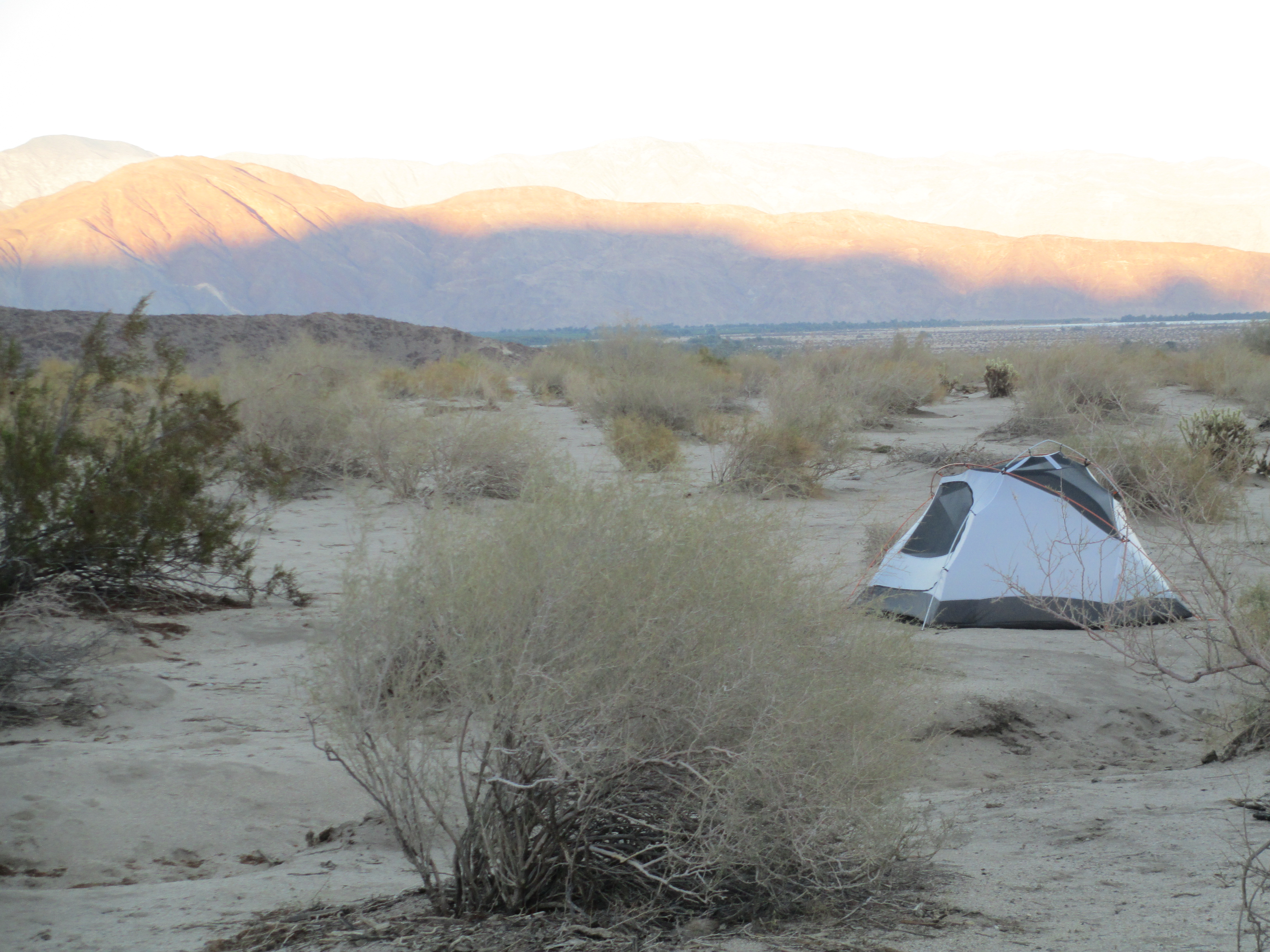
Dusk in the Anza Borrego Desert

Dusk in the Anza Borrego Desert

As I was growing up, my family often camped in California State Parks. In those days, rangers kept the peace. I don’t remember us ever having to deal with people who were too noisy—or for that matter, music being played over the sounds of nature. We kids – put to bed early – were the ones who were told to pipe down. These days, guests are on their own at night—unless they dial 911, which nobody that evening appeared willing to do. And I don’t blame them. What a depressing way to end a day in nature!

The Next Morning

Children occupying other sites wake up early, and begin busily moving about the campground. The desert light has the effect of making the place feel safe once more. I watch as two young boys – deep in discussion – head down the road. People begin riding past my site on their bikes. Some appear to be hiking toward the Palm Canyon Trail, which is my one planned activity (in the afternoon). I finally get in that down time I’d yearned for on earlier trips. The morning continues to be luxuriously slow. I am visited by birds, not to mention a lone jackrabbit that stops to look my way, remaining still for a long time—its two sensitive and very big ears pointing to the sky.

I finally grab my trekking poles and wind my way to the Palm Canyon Trail. This jaunt (1.5 miles one way) leads to an authentic palm oasis tucked deep in a canyon that often has running water. The trees up in there look like lions, big and shaggy. I head toward the grove, hiking for roughly thirty minutes before a hiker coming from the other direction stops me and says, “There are bighorn sheep up the trail.”

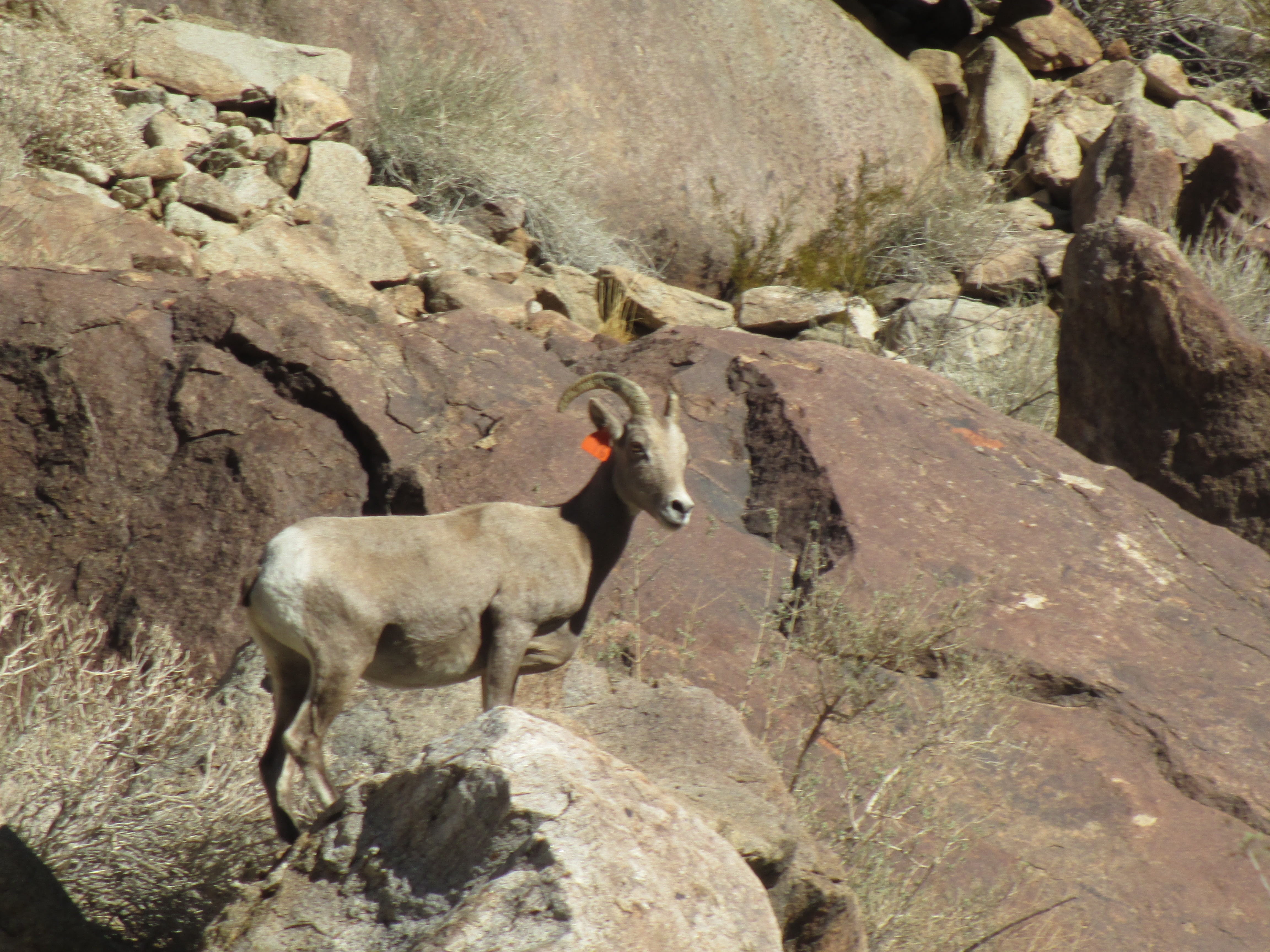
Bighorn Sheep

Bighorn Sheep

And I light up to say, “Thanks.”

“A family of them.”

I begin scanning the terrain. As I walk, more people tell me about the sheep—how they are really hard to see. “They crossed right in front of us!” And I begin to fear I’ve missed them.

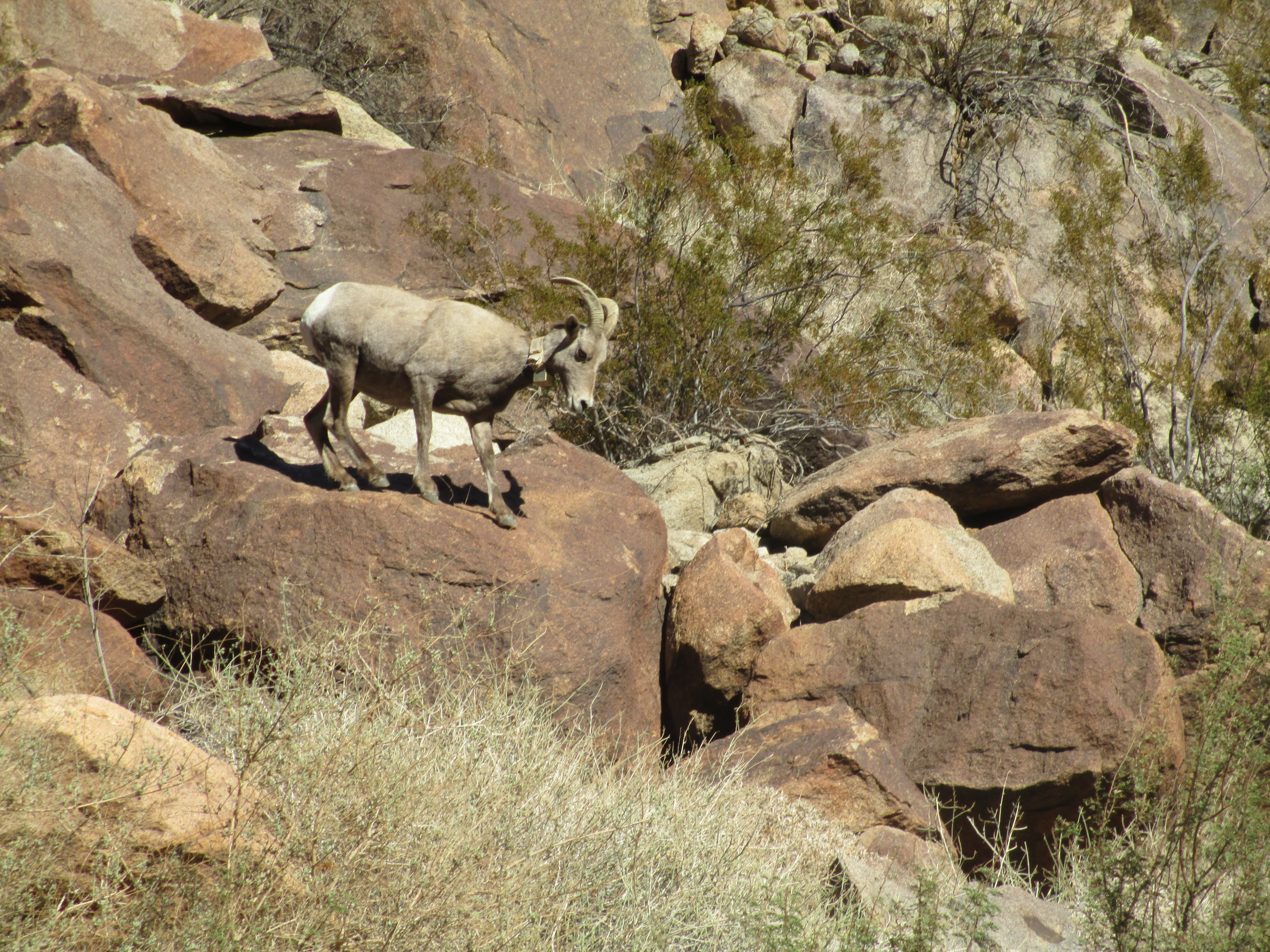
Then I spot four females, on the other side of the creek bed, standing on the steep, rocky incline of the canyon. They are positioned at odd angles, clearly trying to blend in. I fire off a few photos, before gazing at these lady sheep that look like billy goats.

Bighorn Sheep

I want the moment to last, but this is a popular trail, and I can’t be upset at the kid who exclaims, “Oh my God! Bighorn sheep!” which ultimately makes the animals begin to trot. Next thing I know, a pack of kids are running up and down the trail, alerting everyone about the sheep. Meanwhile, the four bighorns calmly move to my side of the canyon, and then up and up and up until they reach the very top. The sky above the ridge swallows them whole.


Pumpkin Soup

I love perusing a good squash selection in produce during the fall. It probably has to do with the hibernation impulse—the need to cook heartier meals in line with the changing scent in the air. Some winter squashes are truly works of art. I usually put the ones I purchase on display for a few weeks, before actually attacking them with a chef’s knife. As an aside, I still enjoy a good pumpkin carving event, though my creations tend to fall sadly short of the company they share.

My squash soup, however, isn’t bad. It’s strange how most pumpkins disappear from the stores after Halloween. Pumpkin can be cooked and puréed into fabulous soups, completely proper for the months that follow October. I guess most folks find it too labor intensive to whip up pumpkin soup from scratch.

I can hardly talk. I tend to be an intermittent chef at best, often finding it difficult to sink into the joy of cooking when there are so many other things to do. During the workweek, I won’t cook anything that takes longer than half an hour to prepare. When I do have time to spare, a robust winter squash can lure me into the kitchen.

I tend to look for recipes that will render a thick, golden soup with an unusual kick of some kind—ginger, cheese, apples, beer, or sizzled sage. I hate the ones that call for peeling the chosen squash de l’hiver, before chopping it up and throwing it into a pot of water. Most average potato peelers just aren’t up to the job. Better to slice it in half (still a risky act), slather the flesh with oil, and bake the two halves in the oven.

Pumpkin doesn’t have to be puréed to make a special appearance in a delicious soup. Cubed, it can be a great addition to minestrones, not to mention your basic vegetable soups.

But there are even more creative ways to whip up a soup that includes pumpkin.

The bisque is set apart from other creamy concoctions in that it requires the puréed meat of crustaceans. If you Google “Pumpkin Bisque,” for example, you will find an assortment of soups showcasing unusual ingredients, such as smoked gouda, curry, sage pesto, maple syrup, or sweet potatoes. Chowder, the elegant bisque’s working class cousin, doesn’t have to be so smooth. Indeed, one expects a certain chunkiness, which cubed winter squash can provide (yes, Pumpkin Chowder recipes abound).

Bouillabaisse, a traditional Provencal soup, can certainly handle the weight of winter squash. Search hard enough, and you will encounter the Pumpkin Bouillabaisse. Or you can boil your pumpkin (along with a chicken) before straining it into a fine Pumpkin Bouillon. Another approach is to cook up your pumpkin, and then cool it down before serving it in a Chilled Pumpkin Soup.

For the Pumpkin Consommé, you will want to chop up some of the said squash, along with onions, garlic, and ginger. Consommé, by the way, is a refined broth that comes about through a fascinating process requiring the use of egg whites to round up unsightly pieces of meat and vegetables, all of which are removed in the end to produce a clear soup.

Pumpkin can anchor the dessert soup. Count on adding plenty of sugar and spice! And wouldn’t you know it? There are even some Pumpkin Gazpacho recipes out there. Then there’s the hearty goulash – coming out of Hungary – that generally consists of beef, pork, potatoes, and tomatoes, but CAN include winter squash (you’ll want to get the seasonings right on this one). Pumpkin is good in gumbos, too.

Moving on to the mulligatawny variety, it appears that some mulligatawnies are not complete without the added punch of pumpkin (of course this Indian style soup, based on a chicken stock, and seasoned with curry, can be perfectly fine without a hint of winter squash).

Tired of your average Chicken Noodle Soup? Why not try a Pumpkin Noodle Soup? Most of these recipes seem to come out of Asia. If you’d rather head South of the Border, there’s always Pumpkin Tortilla Soup.

I have never sampled the French velouté, but it appears this particular soup style meshes well with winter squash. I stumbled onto one Pumpkin Velouté that includes wild mushrooms and scallops with hazelnut oil. Vichyssoise, another French creation, is made of puréed leeks or onions and potatoes, cream, and chicken stock. It is usually served cold. Apparently, pumpkin can be added to the mix for the Pumpkin Vichyssoise.

Finally, I ran a search on Pumpkin Wonton Soup. Yep. It’s been done.


To write this piece, I drew heavily from the following website:

Soup Types – Become A Soup Connoisseur: Learn the Different Types of Soup. The Nibble, 2014. Web. 20 Oct. 2014.

I will be reading in the Twiggs Green Room!

Image

A Turn for the Verse: An Evening of Poetry

In Praise of Smokejumpers

Hurricane Odile hit the southern Baja peninsula last night, and here in San Diego County, we continue to feel the heat. Air conditioners are humming—the power grid is under stress. People are crankier than usual. Those in my water district have been living with Level 2 Drought Alert Conditions for roughly a month (other Californians have been on alert since last spring), and the Santa Ana winds season, which usually occurs during October, hasn’t even begun.

Last May, the county suffered under the effects of some 14 wildfires, the result of unseasonably hot temperatures, low humidity, and northeasterly winds. Fortunately, this threat became muted over the summer, though people in Northern California and the Pacific Northwest struggled with their own equally scary fires during these months.

Even as I write this, I find myself noticing a headline: “Hundreds flee 2 California wildfires; homes burn.” These two fires are currently blazing near Yosemite—and there is another east of Sacramento. And yet another in Orange County.

Sometimes it feels like all you can do is sit and sweat and hope the air will cool down.

In late October of 2007, the college I work for in East San Diego County was closed due to several wildfires, including the Witch Creek Fire and the Harris Fire, which eventually prompted more than 10 percent of the region’s population to leave their homes for awhile. A few of us at my college were asked to come in to work, anyway, to meet with the accreditation team, as it was in the process of assessing our school.

We all assembled in the student center and proceeded to answer questions for the team’s report. I remember stepping outside to take a break, and I could actually see flames on the hills just south of us. Needless to say, the campus was completely evacuated not long after that.

Now my college library hands out fridge magnets—created by the San Diego Office of Emergency Services—that also serve as evacuation checklists. Most people I know have considered just what they will pack in the event of a serious fire threat.

It does feel strange to accept wildfires as a fact of life. They were always a possibility, of course, but somehow they were “over there.” You saw them in the news and figured it was a once in awhile thing. The fires on TV were something daring people attended to while the rest of us continued living in our cozy homes. And some of the most heroic firefighters of all were the people trained to jump out of aircraft into fire zones.

I first learned about this line of work back in the late 70s. At the time, I was a Youth Conservation Corp teen participant under the guidance of the U.S. Forest Service. This group of teens and our respective counselors were spending the summer building fences and digging outhouse holes in Eastern Oregon, when a wildfire erupted not far away.

Our camp was immediately put on alert, though we were not in any immediate danger. While smokejumpers were expected to battle the flames right away—for up to 48 hours at a time without additional help—other crews were already sweeping into the closest tiny town. They proceeded to take over a high school that was closed for the summer (where we also happened to be taking our showers). Their mission was to provide food, showers, and a place to sleep for the smokejumpers and other fire personnel.

As this went on, our own work group received a great deal of information about what was happening (we saw their camp materialize overnight); yet we weren’t allowed into the fire zone until all that was left were some smoky hot spots. We were then treated to a real life demonstration on how to ensure the fire was truly out. Mop up.

In the end, I came away thinking… Well, this doesn’t happen every day, but when it does, we’ve got people trained to get on it. I couldn’t have imagined the efforts it would take to stop the Witch Creek Fire, the Harris Fire, or the earlier Cedar Fire that disrupted San Diego County in 2003. And I couldn’t have imagined this more recent volatile period—one fire after the next erupting in regions I am familiar with, from U.S. border to U.S. border.

Platitudes about how things change just aren’t overly comforting right now.

Update: I encountered this video on Facebook the morning after I posted this piece. It shows scenes from a recent fire in Weed, California.

Poem in Cascadia Chronicle

My poem, “Tsunami Warning System,” has been published by Cascadia Chronicle. This poem was originally published in The Ballad of the New Carissa and Other Poems.

Three poems in The Homestead Review.

My poems, “Midlife,” “Highway One,” and “Remnants,” have been published in the The Homestead Review.

Summer Rain

Shasta daisy start

Shasta daisy start

It started falling last night – rain – more rain – moistening parched places everywhere. It is still coming down, those familiar tings against the roof, the skylight, that have disrupted a few morning plans tied to the sun. The rain is a welcome excuse to read or write or do nothing but listen.

Plans change.

Recently, I was driving up I-5 in Southern California under the usual long-term-drive bubble. Everything was as it should be—a few vehicles in front of me, a few behind. The morning air in the dry and golden valley was promising another sweltering day, though I sat cool and comfortable in my air-conditioned vehicle. Then 70-mph time swung into slow motion surrealism as the semi ahead of me began to derail, snaking into the left lane, ultimately pushing a car off the road while the cars behind it shifted from side to side. I was sure the truck was going to follow along the same trajectory, ending up in the divider zone. The next thing I knew – in slow motion – the long vehicle tipped and landed on its side in the middle of the freeway. I found out later it blocked traffic for over an hour, though I never managed to uncover any mention of injuries or death.

The Buddhist idea that “everything changes except change itself” (also attributed to Heraclitus and John F. Kennedy) has certainly been rebranded to capture the modern imagination. People are constantly coming up with ways to express it in writing these days. And I have sat through a number of earnest conversations that swerved into this sentiment, only to find myself batting about its various nuances.

It feels satisfying to talk about this stuff—in theory. We can all nod along, “Yeah, I know that one.” And we sit there figuring this brilliant conclusion should make life’s surprises just a little bit easier. Yet there still comes a time when we have to ride inside a car that is shifting from side to side, only to wonder if it is going to hit an overturned semi. And no matter what happens, we have to go on from there.

I was lucky. I was able to pull over to the shoulder, hit my flashers, and safely dial 911, even as a line of cars began to file in front of me and around the wreck. Meanwhile, a number of men climbed onto the side of the truck to check on the driver. I told the dispatcher what I had seen, and she eventually released me with an assurance help was on the way. Once I ascertained there was nothing more for me to do, I got into the line of cars crawling along the shoulder and continued traveling.

As I drove, I was surprised to note how calm I felt. A few hours later, though, I experienced a round of nerves that called for a lunch stop. In the end, I was able to make it to my family gathering on time.

The rain is still coming down. It is bringing back my newly planted Shasta daisy. Last week the lone plant endured a two-day drive up highway 101. Before I left, my brother and I took my mother over to the Luther Burbank Home and Gardens in Santa Rosa, so that she could buy the start. Apparently, Luther Burbank – the world-renowned horticulturist – spent 17 years developing what to his mind was the ideal daisy. This variety “would have very large pure-white flowers, a long blooming period, and do well as both a cut flower and garden plant.”1. He worked with four different daisies before he finally introduced his own beauty in 1901. Burbank named the flower after Mount Shasta.

My mother wanted me to plant my daisy start in Oregon, because she thought it would thrive up here. What she likes about Shasta daisies is the fact that a single daisy can quickly propagate into a whole bucketful in a short amount of time. They don’t need much attention, especially in places where it rains regularly.

When I first arrived, I was afraid I was going to have to dash her hopes for a satisfying daisy herd. The already scraggly plant – sans bloom – quickly and dramatically wilted in the new climate that was shifting between glaring sunshine and cool nights. It looked almost dead. I rushed to baby it, wondering if I should even bother getting to the garden store. I grabbed the watering can and gave it a soak. I took it off the deck and placed it on the lawn, away from anything that reflected light. I was worried the lawnmower guy would drive over it before I could buy a shiny blue pot and a bit of earth.

Now the start is looking perky in the summer rain. A lone bloom appears to be on the way.

  1. Shasta Daisy. Luther Burbank Home & Gardens, 2013. Web. 24 Jul. 2014.

IMG_20140829_073330

Living in Two Places

I once overheard one of my colleagues talking about the pros and cons of working in academia. She pretty much implied that while she knew she would always bring home “the medium bucks,” her teaching job was a deeply satisfying labor of love. Of course, good college positions often come with regular academic breaks—an altogether different sort of compensation.

For me this arrangement has meant living in two places. While I occasionally feel too divided between two lives, I enjoy the sense of renewal that comes from returning to a beloved refuge every six months or so.

When the semester ends, I’m eager to head out of San Diego County and drive to the Oregon Coast so that I can pick up where I left off with my small space and my extended family. I do occasionally wonder about how much more traveling I might have done if I didn’t live in two areas—yet I’ve found it sustaining to invest most of my free time in one vacation location.                                                                                 IMG_1247

I have owned my cabin here longer than any other home—and longer than any other life I’ve lived in any other place. As the seasons have passed, so have the tales. I’ve watched mudslides close roads, serious logs pile up on the beach (only to be carried away again), a lighthouse covered over for repairs, and a family of tenacious eagles dive for fish at the mouth of the river. Yes, regular storms invariably work with nature’s muse to deliver plenty of stories for the telling when there’s nothing better to do. I did happen to be holed up here the weekend the bow of the New Carissa made its visit to Waldport (Seattle was my other home then).

When I do finally roll in, turn on the water and electricity, and open the windows, previous years press through my screens. Some things we still talk about have vanished—homes, stores, and restaurants. People have left. People have died. New people have moved in. We don’t have a gas station this summer (we used to have two). And technology sets down its wires slowly. Some people want it, but not as much as folks in the city—and not as often. There’s enough technology.

IMG_1239

There’s also time to pick a bucket of blueberries at the u-pick place. For the ambitious baker, other berries abound: marionberries and raspberries. There’s time to buy a whole tuna right off the dock. People like to get together and talk. Whales hover near the shore during the summer. Rumor has it this pod never makes it all the way to Alaska. They’re happy to stop right here and feed till it is time to head south. I feel a kinship with this pod.

It can be challenging to maintain a dwelling from a distance, particularly during the winter. Winds once blew one of my trees into a neighbor’s yard, my pipes broke during a deep freeze, someone insisted there was a bear on my property, and another called to fret over my roof repair job, which she felt was in danger of being blown clear off. But then, my neighbors here have gotten to me faster than any of my urban neighbors ever have. I’ve never felt better looked after by my neighbors.

I suppose I’ve been developing two voices in recent years. One is influenced by gales, whales, water, gales, green growing greener, IMG_1232more water, purple foxglove, Queen Anne’s lace, yarrow, salal, salmonberries, salmon, and a moon that peeks over the hill to watch the sun sink into the horizon. The other is born of dryness, lizards, whales (the same ones), cactus, ocotillo, yucca, palm trees, snakes, coyotes, and fire. Pasts seated in both Washington and Northern California occasionally surface. I’ve got a whole coastline to ponder (perhaps a few mountain ranges, too), which is more than I really wanted—but life has moved me where it wanted. So this is what I have to write about.