I’m pleased to announce my poem, “Pizza and a View,” was published in the latest online issue of Fourth River.

I’m pleased to announce my poem, “Pizza and a View,” was published in the latest online issue of Fourth River.

The 7th issue of Shift: A Journal of Literary Oddities contains an important milestone for my writing life. The journal recently published my poem, “Hands-free,” which happens to be my 100th poem to appear in a literary journal or anthology. I’ve meant to go over each acceptance and figure out how many of the 50 states I’ve appeared in, but other tasks have taken precedence.
“Hands-free” is a contemplation focused on how my late father’s dreams have bled into my own. It is fitting that such a poem marks this juncture. My father was also a poet. He was, to use his word, tickled, with the idea of seeing his work in print. Yet he was shy about the submission process. The few rejections he did receive had the effect of paralyzing future efforts. Fortunately, he forged ahead with the actual writing of poetry as he went about his days until he passed away in 2002.
I wasn’t actively writing poetry during the years when I listened to my father talk about his work. I regularly wrote newspaper articles back then. I chipped away at a couple of children’s novels. Yet when I could sneak in a visit, he often shared his favorite poets with me, and I felt my interest in poetry pique. Alas, my schedule was weathered by my library career and the aforementioned writing projects.
As I lived my busy life, I often pictured my dad walking a backroad as he took in a stark winter Northwest landscape, say, before stopping to jot down a few lines in his grubby notebook. Every so often he’d mention how he might submit a poem to this rag or that one. I usually did not hear if he followed through on his intention. I do know I would have heard if he’d received an acceptance.
While I’ve experienced my own moments of agony over rejection letters, I have learned how to try again. Though I must admit, I did not discover true resolve over this necessity until I was about 50, some 10 years after my father’s death. I wish he’d lived long enough to have known the 50-something (and now 60-something) me. If he had, I would have rolled up my sleeves and helped him develop a system for submission. I would have employed my methodical way of sending batches of poems out to journals around the country, if not the world. Because I am certain my father’s acceptances do exist in some parallel universe. Though I am not sure if I will ever be free of the wistfulness I feel over the intermittent “if only” that continues to prick my thoughts.

Cold River Press is running a discounted presale through May 12!
Kari Wergeland’s Wannabe Blue is a compelling and philosophical poetry collection characterized by close observation ‘The little shark has kitten teeth, / black button eye. / Its mouth hinged open’, wariness ‘Danger could open up anywhere / Just this thought wrings a drop of awe from the morning’, and yearning for something beyond all the anxieties we face ‘I want the world to be / about love and creativity— / colorful trinkets by the sea’. These are poems to visit again and again to find the place inside us where solace begins.
— Lucille Lang Day, author of Birds of San Pancho and Other Poems of Place, editor of Fire and Rain: Ecopoetry of California
The poems in Wannabe Blue describe Kari Wergeland’s wide-ranging recollections with well-honed poetic craftsmanship. There is a fine mix of free verse lyrics and occasional pieces of formal poetry as in the lovely sonnet titled “Old Photos”. The poet has an ability to compress stories from various time periods into a single poem, handling with ease and an adept use of language, the move from a present time glimpse of a coyote to past memories of a father who smoked when she was in elementary school. Conversations during two different visits to the beach, appear to be in stark contrast only to the poet herself, whose loss of her hair between those visits makes an understated, but moving, reference to her cancer. This collection gives occasional glimpses of California, seen as the vivid color of bougainvillea, brilliant against the green grays of the Pacific Northwest. Underlying these places, layers of history break through in the form of miners’ panning for gold and old ghost towns crumbling into the present time and into the poet’s imagination. Interspersed among the histories are moments of whimsy that will make you smile, like the grapevines whose trunks twine together ‘as if preparing to dance’, or the dry leaves that fell ‘up into the air’, on ‘the day the waves broke backwards.’
— Judith Barrington, author of The Conversation, Long Love: New & Selected Poems, 1985-2017 and Virginia’s Apple: Collected Memoirs

I’m pleased to announce my poem, “Moonwatch,” has been published in the Objects in the Mirror edition of Caesura Online. My poem “Ocean of Stars,” has been published in the print edition.

I fell in love with dance while I was an undergraduate at the University of Oregon. As I knocked out a degree in English – after changing my major several times – I became an adult new dancer, sampling modern, jazz, and ballet in Oregon’s dance program. I also joined an audience of dance aficionados and have loved the art form ever since. Though when my library career pulled me into the fray, my focus went to other things.
Now that I’m living on the other end of my career, I’m finding myself taking in more dance concerts. Last Friday, for example, I was captivated by Sacramento Ballet’s wonderful production of Swan Lake. As I sat amid a sizable audience, I felt the twenty-something version of me perking up. That old passion is still there. I no longer study dance, though I’m currently waitlisted to join a second wind dance class taught by Pamela Trokanski. I could use some weight-bearing exercise to ward off the onset of osteoporosis, which can be caused by the cancer drug I continue to take.
Speaking of Pamela Trokanski, she’s directing a show this weekend, the Davis Dance Project: Art in 4 Dimensions. Like everything else, this annual event went dark during the pandemic. Trokanski has gathered her dance company, along with local musicians, visual artists, and poets (I happen to be one), to create pieces that are an amalgam of all these art forms. Trokanski kicks off the performance with a useful review of the choreographer’s palette in her lecture demonstration. Nice pieces follow, showcasing the work of Parto Aram, Analisa Bevan, Robin Lee Carlson, Joan Jarvis, Binuta Sudhakaran, Hank Lawson, Meri Superak, Ann Dragich, Erin Dunning, Taylor Herrera, Tase’, Pamela Trokanski, Allegra Silberstein, Kari Wergeland, Skye Falyn, Jack Collins, Sterling Anderson, and Lamondo Hill. You’ll have to attend to see how all of these voices fit together!
Saturday, February 25 @ 7:00 pm
Sunday, February 26 @ 2:00 pm
Louise H. Kellogg Memorial Theater
Pamela Trokanski Dance Workshop
2720 Del Rio Pl
Davis, California

This year I managed to post one blog piece, kicking off 2022. The rest of the year slid past me, though that doesn’t mean I wasn’t using my voice. I was busy with agent queries, a bit of poetry writing, and revisions on my set of linked short stories. Yet none of these endeavors insisted on a blog post. I’m remembering how I started this blog in 2012 to explore the idea of voice and vocal problems. In an attempt to round out not only the past year, but also the last decade, I will offer an update on the state of my voice.
I hit a milestone when Finishing Line Press accepted my novella, Off the Wall, last September. While I’ve had a few short stories published, Off the Wall will be my first full-length paperback (if you discount my self-published collection of poetry). The novella stars Sadie Taube, the daughter of a deceased heroin addict. She’s living on Bainbridge Island, Washington, with her aunt and uncle in their big ass house. While they treat her all right, she’s not exactly their daughter. She’s been working in a diner and saving every penny. The restaurant is warm and friendly, decorated with the dollar bills customers have left behind. When Sadie turns 18, her boss Bev asks her to stay after work so they can celebrate. Bev doesn’t know she has a plan brewing, one focused on the Coast Starlight. Sadie is gonna get on that train and head to California. Yet during this last hurrah she finds reason to track down a little extra money (when Bev isn’t looking). Off the Wall is due out next fall.
What I like about poetry writing is the way commercial aspects do not play into the publishing process all that much. I can tinker with work and get it out there. But I can’t expect a lot of recompense. So I don’t. Writing poetry allows me to experience the joy of writing without feeling pressures focused on agents and editors, or the tough publishing market. Feeling that joy has its own reward. Once a poem is out in the world, it claims its own destiny. It can live or die, as necessary.
And yes, I’m still singing. During the first year of the pandemic, I connected with a voice teacher on the Oregon Coast who was willing to work with me either on her porch (as she guided and accompanied me through the window), as well as via FaceTime (during times when I was working as a librarian in California). My teacher uses the Joseph Klein technique, which initially felt like a dubious challenge as it differed from anything I’d done before. Yet this approach has helped me fix a number of problems. For example, evening my upper register with my lower register has been a major snafu for me since day one. We are now in our third year together, and I continue to be amazed at my teacher’s ability to push me to the next step. This fall she assigned “O cessate di piagarmi” by Alessandro Scarlatti, as well as “Nel cor più non mi sento” by Giovanni Paisiello. As I live in Davis, California, when school is in session, I’ve been trying to do my best with these pieces through FaceTime. I’m looking forward to my next in-person session with her so that she can truly assess my progress.
Finally, I haven’t stopped exercising my library voice, and I’m not talking about shushing people when I’m sitting on the reference desk. Community college librarians have been charged with the task of helping people work through the maze of misinformation, disinformation, and fake news. It takes work to develop the sort of critical thinking necessary to pinpoint quality sources. I stand ready to cheer on any student willing to deepen their information literacy skills. As an FYI, I will be teaching Library Research and Information Literacy online through Sacramento City College this spring (March 20 to May 12).
Happy New Year!
My poem, “Animation,” was recently published in Broad Street.

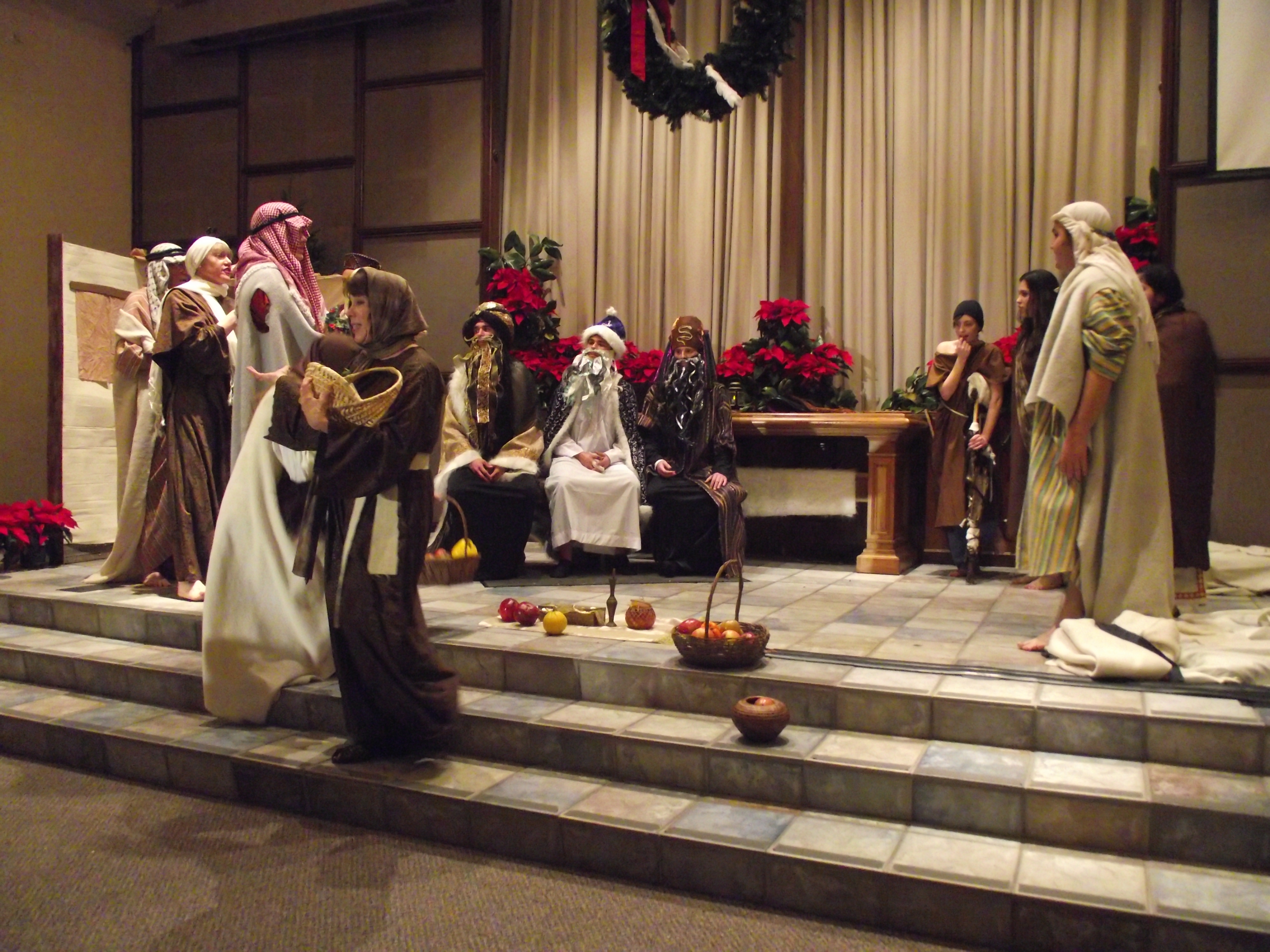
Amahl and the Night Visitors performed by The San Diego Ecumenical Opera, December 2010.
I’ve been calling myself semi-retired, from the library world anyway. I’m not completely ready to stop working. A community college in Northern California interviewed me last summer, before putting me on their adjunct list—they may have some hours for me spring semester. If all else fails, I can always work part-time for my old school in San Diego County. Meanwhile, I’ve been taking a breather in my cabin on the Oregon Coast, working on my health, and getting a lot of writing done. I’ve certainly begun promoting my new chapbook, Breast Cancer: A Poem in Five Acts. And I’m back in the Central Coast Chorale. We’re preparing for a series of holiday concerts slated to take place in Lincoln County, Oregon, this December.
I was waiting for our second rehearsal to begin when one of my sister singers told me about another coastal production scheduled for December, Amahl and the Night Visitors. This was going to be a joint effort between the Porthole Players and The Newport Symphony Orchestra. The people sitting near me continued to natter on. Apparently, there is one day where individual performances of Amahl overlap with the choir concert—somewhat. “No matter,” one singer said. “We’ll run up to Lincoln City to perform the matinee concert, and then we’ll return to Newport to get ready for Amahl.” I must have looked interested, because she went on to tell me when auditions were (that same weekend). Then she informed me where I could locate the music online—for the audition.
I found myself mulling the possibility over. I’d performed in the chorus of Amahl and the Night Visitors in 2010. This was a student production, directed by my voice teacher, Esther Jordan. I actually outlined my road to this unlikely opportunity in my memoir-in-verse, Voice Break. I decided I could probably remember my old part for the audition—get it ready for the next day.
It felt a bit eerie to enter the smaller performance studio in the Newport Performing Arts Center, a room rimmed with black curtains. While I’d auditioned for three choirs in the last ten years (a process that generally consists of singing scales and exercises revealing how well a singer sight-reads), I hadn’t tried to audition for a show with a prepared song since the age of 25 (and for the record, I’m now 56). However, I had been working on my singing. Before leaving San Diego County, I studied with my voice teacher for more than seven years. And I now have almost five years of choir singing under my belt—time with the three different choirs.
To repeat, I had not tried out for a musical theater production since my twenties (and by the way, I was never cast in a musical back then). I did get to taste a small speaking role in The Taming of the Shrew at Lane Community College (in Eugene, Oregon). And I appeared in a few dance concerts, but I never sang on stage during my initial tango with the performing arts. My passion for all of this eventually fell by the wayside when I became serious about my library career. I began working for the Seattle Public Library in the late eighties—my first librarian job—and this took up the bulk of my time.
But now I’m a retiree!
When it was my turn to audition for Amahl and the Night Visitors, I handed the music for Come Ready and See Me to the accompanist and then moved to stand before the director, Bonnie Ross, the producer, Rhodd Caldwell, not to mention a handful of other hopeful performers. They were a friendly bunch—I didn’t feel too nervous. Besides, I’d just run through the one-minute selection twice in my cabin with no wobbles. Yet this time when I sang the first few measures, I immediately felt my start was weak, maybe not a wobble, exactly. The acoustics felt weird. As I continued singing, I strove to focus, work better with the accompanist. I was thinking I was settling into the song. But when I was finished, the director said, “Now sing it like you want to sell it.” An ouch? So this time I tried to put pizazz into my stance and sing with more gusto. After a few seconds she said, “Thank you very much.”
On to the music for Amahl.
The night before, I’d prepared for the chorus, soprano part. That was all I wanted to shoot for—nothing huge. There were two other women in my group, both trying for soprano. First, the director had the three of us sing the soprano line. Then she had me and one other woman sing the alto line. Then she moved me back to soprano. She invited the men to join in. At some point, we all sang as a chorus. After this grand finale, I was able to breathe a sigh of relief and head to Starbucks. They were moving on to cast the leads.
A few weeks later, I got the call. The director offered me the part of singing shepherd. Retirement is an adventure, I guess.
#
Amahl and the Night Visitors will take place on Saturday, December 8 at 7:30 pm and Sunday, December 9 at 2:00 pm in the Newport Performing Arts Center.
The Central Coast Chorale will be performing their annual Wishes & Candles holiday concert in three locations:

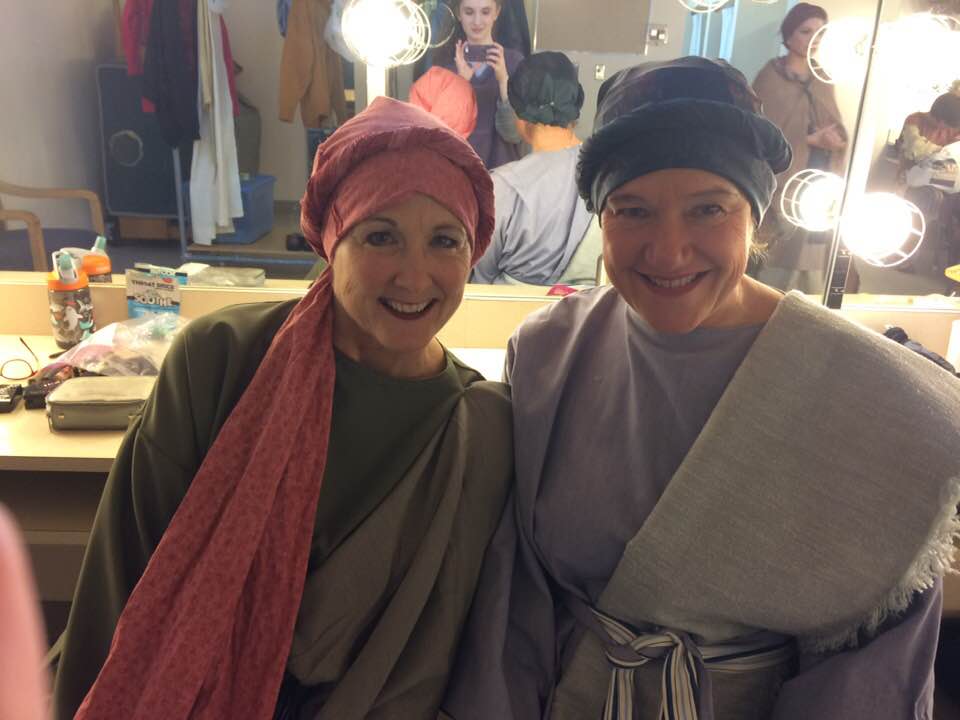
Getting ready for Amahl and the Night Visitors – performed by the Porthole Players and the Newport Symphony Orchesta.
Signing books in Toad Hall (Yachats, Oregon).
I will be signing copies of my books at the Florence Festival of Books in Florence, Oregon, on Saturday, September 29th between 10 am and 4 pm. The festival will be held in the Florence Events Center on 715 Quince Street.

Last month, I launched Breast Cancer: A Poem in Five Acts in the backyard of my close friend, Patricia Santana, a writer in her own right. Patricia and her partner, Jack Madowitz, went all out with the food and drinks—the ambience. They set up extra tables and chairs. They took charge of my sales so I could mingle. And though it is difficult to relax into a party when you are the planned entertainment, I was able to enjoy the good wishes and hugs, the repast even. I hadn’t seen many of these folks since my retirement from Cuyamaca College, over a year ago, because I left San Diego County to embark on various adventures while also designing my next leg of life. It was nice to catch up—celebrate the summer, not to mention Patricia’s own more recent retirement from the school. Yes, they were expecting me to read—and then sign books. That was whole the point.
I was pretty relaxed as I stood, book in hand, about to deliver sections to an audience for the first time. I felt honored to be introduced by a writer I admire, particularly for her willingness to be honest. I’m certainly proud to be her friend. What I wasn’t expecting, though, was this on-the-spot realization I’d opened myself up for personal questions. In writing the book, I’d had complete control over what I focused on and what I left out. Besides, a book becomes an organic boundary between writer and reader, a place to stow painful revelations that don’t have to be openly discussed.
As I scanned the familiar faces, the thought came to me that anything could come up during Q & A. While this may seem like a no-brainer, I hadn’t contemplated how it would feel to discuss the finer points of what medical personnel did to my left breast—this to a group of colleagues and friends. I made the decision then and there to lean toward openness. I did wonder if I’d regret it later, squelching the bout of awkwardness that flared as I rambled into my “time for questions” line. I found myself signaling a willingness to answer things about my medical situation in order to put people at ease. If a person needed clarification about some aspect of this painful disease, I was going to try and offer it. I was the one who’d opened the door to this possibility.
I was already finding the evening a bit of a balancing act—being sensitive to those I knew had gone through breast cancer (or were going through it) while also responding to those who’d never dealt with the disease. I’m well aware breast cancer victims have varying experiences with their treatment. I also know my situation isn’t the most painful case on record. I didn’t want to upset anyone whose condition was worse than mine.
People went easy on me. Maybe they felt awkward, too. Most questions were of a philosophical nature, “How have things changed about the way you view your life, now that you’ve gone through breast cancer?” Or something to that effect. I was happy to explore this territory instead of inquiries like, “Did chemo make you puke?” Still, I haven’t changed my mind about answering the puke question—or ones like it (though I’m sure I’ll discover where my line falls, should I continue to share this book in person). I don’t want to tuck this side of my life out of public view, because I’ve learned so much from the nitty gritty tales that unrolled before me as I began heading down this road. I’m still collecting anecdotes and probably always will. Some people’s stories allowed me to mentally prepare, some helped me work through specific aspects of treatment, and some diverged from what I actually experienced. All were worthy of contemplation, maybe a stick of incense. There is a certain density to this sort of storytelling that has the capacity to cushion cancer victims, not to mention those who love them.